Why Visit Deauville in 2026?
Deauville is the kind of place that makes you slow down without ever feeling bored. It’s a small seaside town on the Normandy coast, but it behaves like a glamorous city: grand Belle Époque villas, a legendary casino, luxury boutiques, horse races, film festivals, and one of the most iconic boardwalks in France.
I’ve been visiting Deauville regularly for over a decade, and every time I arrive at the station and catch that first whiff of salty air mixed with butter from the nearby bakeries, I remember why travelers fall in love with this place. Deauville is perfect if you want:
- A chic seaside escape just two hours from Paris.
- Family-friendly beaches with shallow waters, colorful parasols, and plenty of space.
- Romantic walks along the Promenade des Planches at sunset.
- Horse culture: races, auctions, stud farms, and even beach horse riding.
- Easy day trips to Honfleur, Trouville-sur-Mer, Cabourg, the Pays d’Auge countryside, and the D-Day beaches.
- Food heaven: butter, cream, cheese, seafood, cider, and calvados.
In 2026, Deauville is leaning even more into its identity as a cultural and sporting hub on the Normandy coast. With expanded programming around the American Film Festival, new equestrian events, and refreshed seaside facilities, it’s an excellent year to plan 3, 4, or 5 days in Deauville.
Quick Overview of Deauville
Deauville sits on the Côte Fleurie (Flowery Coast) in Normandy, facing the English Channel. It’s often mentioned in the same breath as Trouville-sur-Mer, its older, slightly more down-to-earth neighbor across the river Touques. Deauville is known as “the 21st arrondissement of Paris” because so many Parisians have second homes here and come down for weekends year-round.
The town itself is compact: you can walk almost everywhere in 15–20 minutes. The vibe changes dramatically with the seasons — I’ve experienced Deauville in stormy January when it felt like my private seaside village, and in September during the American Film Festival when the streets were buzzing with actors, photographers, and film lovers.
In this travel guide for Deauville, I’ll cover both the classic must-see attractions and the smaller, hidden gems I’ve discovered over multiple trips — from quiet morning walks in the villa districts to the bakery where I always grab a still-warm croissant before heading to the beach.
Neighborhoods & Areas to Explore in Deauville
Deauville isn’t a big city with sprawling districts, but it does have distinct areas that each feel different when you wander through them. Understanding them will help you choose where to stay and how to structure your 3, 4, or 5 day itinerary for Deauville.
1. Seafront & Promenade des Planches
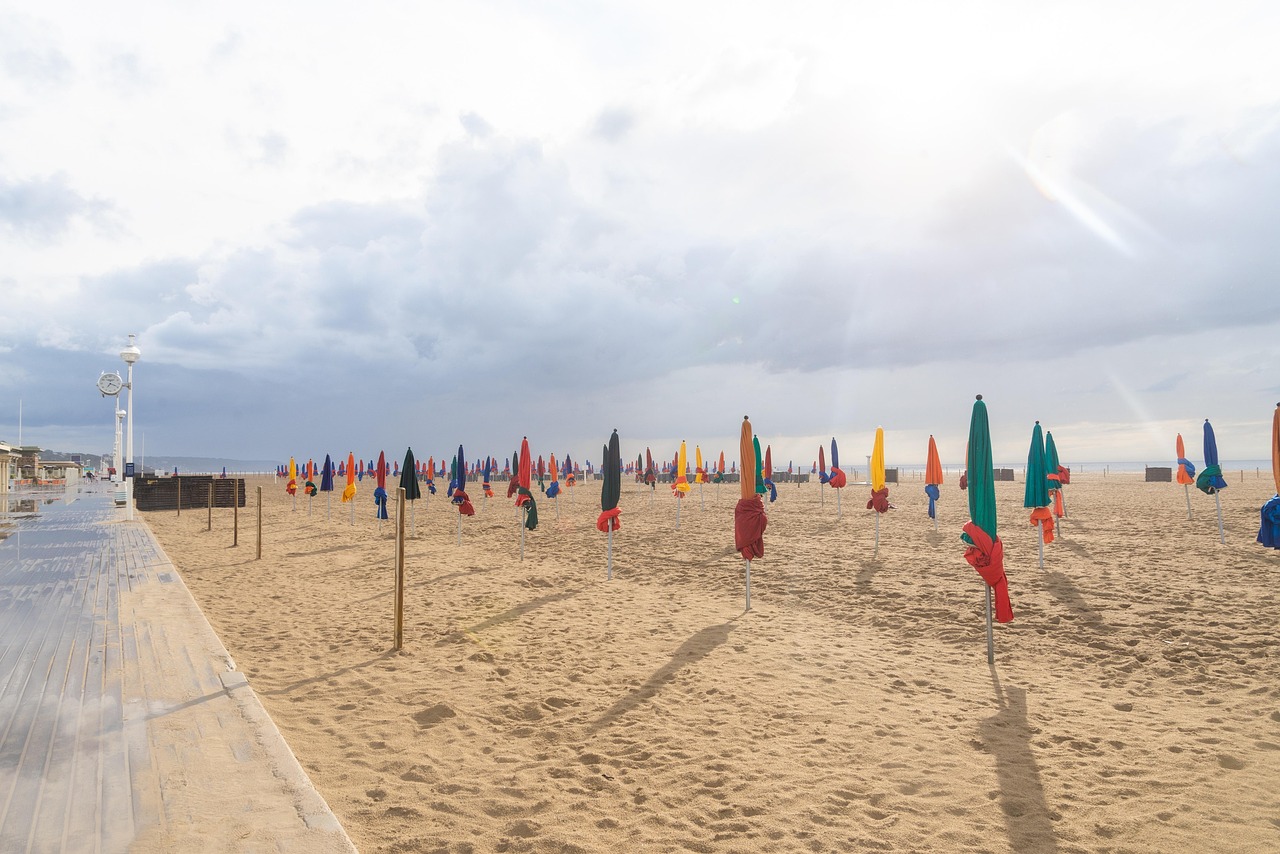
This is the iconic Deauville you see in photos: the long sandy beach, the wooden boardwalk lined with cabins named after Hollywood stars, and rows of candy-colored parasols planted in the sand. It’s where I always start my first walk in town, no matter the season.
2. Town Center & Place Morny
The commercial heart of Deauville, with shops, cafés, brasseries, and the covered market. Place Morny is where you feel the town’s pulse: kids on scooters, locals walking dogs, older couples heading to the market with baskets.
3. La Presqu’île & Marina Area
The area around the port and marina, with modern architecture blending into traditional Norman style. It’s a lovely place for an evening stroll when the boats reflect in the water and the sky turns pink.
4. Villa Districts (Belle Époque & Anglo-Norman Villas)
Behind the seafront, quiet residential streets hide some of Deauville’s most beautiful architecture: timber-framed villas with intricate details, manicured gardens, and that feeling of old-school French seaside luxury.
5. Hippodrome & Equestrian Area
Close to the town center but feeling like a different world, the racecourse and surrounding training grounds remind you that Deauville is one of France’s horse capitals.
6. Deauville-Trouville Axis
The bridge over the Touques river connects Deauville with Trouville-sur-Mer. Many visitors (myself included) treat the two as one extended stay: refined Deauville and more laid-back, old-school Trouville. Plan at least half a day on the Trouville side.
Top 20+ Must-See Attractions in Deauville (With Local Insights)
Below are the must-see attractions in Deauville that I return to again and again. I’ll weave many of them into the 3 day, 4 day, and 5 day itineraries later, but here you’ll find a deeper dive into each place, including history, significance, and personal tips.
1. Promenade des Planches & Deauville Beach
The Promenade des Planches is the beating heart of Deauville’s seaside life. Built in the 1920s, this wooden boardwalk runs along the vast sandy beach, with rows of beach cabins whose doors bear the names of film stars who attended the Deauville American Film Festival.
My first memory of Deauville is walking here on a windy March afternoon, the beach almost empty, gulls wheeling overhead, and the sea mist blurring the horizon. Even out of season, the Planches have a cinematic quality — you can almost imagine yourself in a black-and-white French film.
What to do: Stroll at sunrise when the beach is quiet and the light is soft. Rent one of the iconic parasols in summer (reserve ahead on busy weekends). Let kids run wild on the sand; the beach is wide and flat, ideal for families. In winter, bundle up and watch the waves crash.
Food tip: I like to grab a takeaway coffee and pastry from a bakery near Place Morny, then walk down to the beach and have “breakfast with a view” sitting on a bench along the Planches.
Getting there: From the train station, it’s a 15–20 minute walk through town. Just follow signs to “Plage” (beach).
2. Casino Barrière de Deauville
Opened in 1912, the Casino Barrière is one of Deauville’s most iconic buildings, a grand Belle Époque palace glowing at night just behind the seafront. Even if you don’t gamble, it’s worth stepping inside to admire the chandeliers and feel a bit like you’ve slipped into a scene from a French novel.
I’m not a big gambler, but I do enjoy occasional evenings here — not to win money, but to people-watch. Parisians dressed for a glamorous weekend, locals who know the staff by name, occasional tourists nervously trying their first roulette spin.
What to do: Explore the gaming rooms (bring ID). Catch a show or concert in the theater if there’s something that interests you. Have a pre- or post-dinner drink at the bar just to soak in the atmosphere.
Dress code: Smart casual at minimum, especially in the evening. It’s not as strict as decades ago, but flip-flops and beachwear will feel out of place.
Tip: If you’re on a budget, set a firm limit before you go and treat it as the cost of entertainment rather than a way to make money.
3. Hippodrome de Deauville-La Touques (Racecourse)
Deauville is inseparable from horses. The La Touques racecourse, opened in 1864, is one of France’s most prestigious flat racing tracks, hosting major races in summer and winter. Even if you’ve never been to a race before, it’s a fascinating cultural experience.
The first time I attended a race here was on a spur-of-the-moment decision: I heard the distant announcement over speakers and followed the sound. I ended up spending the afternoon leaning on the rail, cheering alongside locals who happily explained the basics of betting to me.
What to do: Check the race calendar ahead of your trip (especially July–August). Spend a few hours watching the races, wandering between the stands and the paddock where horses are paraded before each race.
Family-friendly: Yes. Kids often enjoy seeing the horses up close, and race days have a festive atmosphere.
Tip: Arrive early to avoid queues and to find a good spot near the finish line. If you’re not into betting, you can still follow the program to know which horse is which and pick favorites just for fun.
4. Villa Strassburger
Villa Strassburger is a magnificent Anglo-Norman villa built in 1907 for Baron Henri de Rothschild and later owned by American newspaper magnate Ralph Beaver Strassburger. Today, it’s classified as a historical monument and occasionally open to the public for tours and cultural events.
I visited during European Heritage Days one September and was struck by how perfectly it captures Deauville’s golden age: elegant half-timbering, intricate woodwork, and interiors that feel like they’re waiting for a glamorous 1920s party to begin.
What to do: If your visit coincides with open days or guided tours, don’t miss it. The gardens alone are worth a stroll. Bring a camera; the architecture is photogenic from every angle.
Tip: Check with the Deauville Tourist Office or official city website for visiting dates. Outside of events, you can still walk around the exterior and peek through the gates.
5. Port & Marina of Deauville
The port area stretches from the yacht marina to the Touques river, facing Trouville. It’s especially pretty at golden hour, when the masts reflect in the water and the sky softens into pastels.
Whenever I stay in Deauville for more than a couple of nights, I make a habit of walking along the marina in the evening. It’s calmer than the center, and you get that peaceful “end of the day by the sea” feeling that’s hard to describe but easy to recognize once you’ve felt it.
What to do: Stroll the quays, watch boat owners tinkering with their vessels, and stop for a drink on a terrace overlooking the water. Some boat trips and sailing schools operate here in season.
Romantic: Very. It’s one of my favorite spots for a low-key romantic walk after dinner.
6. Place Morny & Town Center
Place Morny is Deauville’s central square, ringed by cafés and shops with a fountain at its heart. It’s not grand in a Parisian sense, but it’s where everyday life happens — where I’ve spent many mornings with a book and a coffee watching the town wake up.
What to do: Start the day with a coffee on a terrace, browse nearby boutiques, and wander down the radiating streets to discover bakeries, chocolatiers, and small independent shops.
Tip: If you’re staying in Deauville for 3–5 days, you’ll pass through here constantly. It’s a good orientation point: from Place Morny, signs to “Plage,” “Casino,” and “Gare” (station) will get you almost anywhere.
7. Marché de Deauville (Market)
The market in Deauville (usually centered around Place du Marché and the covered market hall) is a sensory feast: mountains of oysters, glistening fish, ripe Normandy cheeses, butter that looks almost too yellow to be real, and seasonal fruits and vegetables.
On one of my longer stays, I rented a small apartment and made a ritual of shopping here in the morning: a handful of crevettes roses (shrimp), a wedge of Pont-l’Évêque, a baguette, and some cider. Lunch sorted for less than the price of a single restaurant dish.
What to do: Visit in the morning (check days and times, often Tuesday, Friday, Saturday, and holiday periods). Taste local specialities, buy picnic supplies, and if you’re self-catering, stock up on fresh produce.
Money-saving tip: This is one of the easiest ways to save money in Deauville. Eating market picnics for lunch and splurging on dinner balances the budget nicely.
8. Église Saint-Augustin
Saint-Augustin is Deauville’s main church, built in the late 19th century in a mix of neo-Gothic and neo-Romanesque styles. It sits slightly inland from the seafront, with a peaceful square in front.
I often duck inside on hot summer days — it’s cool, quiet, and a nice counterpoint to the more glamorous side of Deauville. Candles flicker, and the muted light through the stained glass gives the place a reflective calm.
What to do: Step in for a few minutes when passing by, especially if you’re interested in architecture or religious history. Check if there are any organ concerts or choral events; they occasionally host cultural programming.
9. Belle Époque & Anglo-Norman Architecture Walk
Deauville’s villa districts are an open-air museum of early 20th-century seaside architecture. Half-timbered façades, steep roofs, ornate balconies, and lush gardens give the town an almost storybook feel once you step away from the main streets.
One of my favorite things to do, especially in the late afternoon, is to wander with no fixed route, letting curiosity guide me. I’ve discovered tiny cul-de-sacs with houses that look like they belong in a Normandy fairy tale.
What to do: From the seafront, head inland on side streets and loop around the blocks between the beach and the racecourse. Bring a camera and comfortable shoes.
Respect tip: These are private homes. Admire from the sidewalk and avoid peeking too obviously into gardens.
10. Thalasso & Spas of Deauville
Being a Norman seaside resort, Deauville naturally embraced thalassotherapy — seawater-based treatments designed for relaxation and wellness. Several high-end hotels have integrated spas and thalasso centers.
On one rainy November visit, when the idea of walking the beach in the wind wasn’t appealing, I booked a half-day thalasso package. After an algae wrap, seawater jets, and a long soak in a warm seawater pool, I emerged feeling like I’d slept for twelve hours.
What to do: If your budget allows, book at least one half-day spa or thalasso experience, especially if you’re spending 4 or 5 days in Deauville. It pairs beautifully with long walks and good food.
Tip: Book ahead in high season (July–August, festival periods), and look for midweek deals if your dates are flexible.
11. Centre International de Deauville (CID)
The CID is Deauville’s main convention and event center, located near the seafront. It hosts everything from the American Film Festival to business conferences and concerts.
Most travelers will encounter it from the outside — during festivals, the red carpet and press zones appear here. During one September visit, I spent an afternoon people-watching from a café terrace nearby as film fans rushed to catch screenings.
What to do: Check if there are public events, screenings, or exhibitions during your stay. Otherwise, just be aware that much of Deauville’s cultural agenda gravitates around this building.
12. Deauville Pony Club & Horse Riding on the Beach
For horse lovers (or the horse-curious), Deauville is a dream. Various riding centers offer beach rides in season, and pony clubs introduce children to riding in a safe, fun environment.
One crisp autumn morning, I joined a small group ride that took us along the shoreline at low tide. The sound of hooves in the wet sand and the open horizon ahead is a memory that’s hard to beat.
What to do: Book a beach ride if you’re comfortable on a horse, or inquire about beginner-friendly outings. Families with children can look for pony rides and introductory lessons.
Tip: Beach riding is often restricted to certain times (tides, municipal regulations), so plan ahead.
13. Trouville-sur-Mer (Just Across the River)
Technically a separate town, Trouville-sur-Mer is so close and so intertwined with Deauville that it deserves a place on this list. The two are connected by a short bridge over the river Touques, and many locals commute back and forth on foot.
While Deauville feels polished and elegant, Trouville is more old-school seaside: a lively fish market, slightly faded but charming Belle Époque façades, and a beach lined with old villas.
What to do: Visit the fish market (marché aux poissons) and eat seafood at one of the casual stalls. Walk the Trouville boardwalk, then climb up behind the town for viewpoints over both Trouville and Deauville.
Budget tip: Eating in Trouville can be slightly cheaper than Deauville, especially for seafood.
14. Les Franciscaines – Deauville’s Cultural Hub
Housed in a former convent, Les Franciscaines is a modern cultural center combining museum, media library, and exhibition spaces. It’s become one of my favorite places in Deauville when the weather turns or when I’m craving a dose of art and quiet.
The renovation is beautifully done: vaulted spaces meet contemporary design, and exhibitions range from photography to painting to installations related to Deauville’s cultural life.
What to do: Check current exhibitions, wander through the permanent collections, browse the reading areas, and take a break in the on-site café.
Family-friendly: Yes. There are often children’s activities and spaces where kids can quietly explore books and multimedia.
15. Golf Barrière Deauville
Set on the heights above Deauville, the Golf Barrière offers sweeping views of the sea and countryside. Even if you’re not a golfer, the landscape is gorgeous — rolling green, scattered trees, and glimpses of the town below.
I’m a casual golfer at best, but one sunny September afternoon I joined friends here for nine holes and was surprised at how much the scenery alone made it worth the trip.
What to do: Play a round if you’re into golf, or inquire whether you can access the clubhouse terrace for a drink with a view.
Tip: Reserve tee times in advance, especially on weekends and during holiday periods.
16. Pays d’Auge Countryside & Cider Route (From Deauville)
Within a short drive of Deauville, the landscape changes into the gentle hills and orchards of the Pays d’Auge, one of Normandy’s picture-perfect regions. Timber-framed farmhouses, apple trees, and small villages famous for cheese and cider make this an ideal half- or full-day escape.
On my first 5 day itinerary for Deauville, I dedicated one day entirely to the countryside — tasting cider at a family-run farm, driving small lanes, stopping whenever a church steeple or cluster of houses caught my eye.
What to do: Visit cider and calvados producers (some require appointments), stop in villages like Cambremer or Beaumont-en-Auge, and enjoy long, lazy lunches in traditional inns.
Tip: You’ll need a car for this; rentals are available near Deauville station.
17. Honfleur (Day Trip)
About 25–30 minutes by car from Deauville, Honfleur is one of Normandy’s most beautiful port towns, with a historic harbor that has inspired countless painters. It’s an easy and highly recommended day trip.
I often pair a morning in Deauville with an afternoon in Honfleur when I’m on a longer stay. The contrast between Deauville’s broad beach and Honfleur’s intimate harbor is striking and satisfying.
What to do: Stroll the Vieux Bassin (old harbor), visit the wooden church of Sainte-Catherine, and explore narrow lanes filled with galleries and crêperies.
18. D-Day Beaches (Historical Day Trip)
While not in Deauville itself, the D-Day beaches and related museums are close enough to incorporate into a 4 or 5 day itinerary. They offer a powerful, sobering complement to the lightness of a seaside holiday.
On one of my trips, I joined a guided tour that picked me up in Deauville and spent the day visiting a selection of beaches, cemeteries, and museums. Returning to Deauville in the evening, the town felt different — still beautiful, but layered with a deeper sense of place and history.
What to do: Choose a guided tour or rent a car and visit key sites like Omaha Beach, the American Cemetery at Colleville-sur-Mer, and Arromanches.
19. Hippodrome de Clairefontaine (Nearby Racecourse)
A few kilometers from Deauville, Clairefontaine is another racecourse known for its friendly, family-oriented atmosphere. It hosts flat, hurdle, and steeplechase races in a green setting.
If you’re in Deauville for 5 days and enjoy equestrian culture, pairing La Touques and Clairefontaine gives you a fuller picture of the local horse scene.
What to do: Check race days, bring a picnic, and enjoy a more relaxed racing experience than at La Touques.
20. Sunset Viewpoints & Seafront Architecture
Finally, don’t underestimate the simple joy of walking the seafront at sunset, watching the changing light on the villas, the casino, and the beach. Many evenings, my entire “plan” is just to do that — no tickets, no reservations, just following the sky as it turns orange and pink.
What to do: Walk from one end of the beach to the other, occasionally turning to look back at the town. If you’re with someone special, this is one of the most romantic things to do in Deauville.
3–5 Day Itineraries for Deauville (With Personal Stories)
Planning 3 days in Deauville, 4 days in Deauville, or even 5 days in Deauville is easier when you understand the rhythm of the town. Below are suggested itineraries based on my own stays — each day blends must-see attractions in Deauville, hidden gems, and plenty of local food.
3 Day Itinerary for Deauville
If you have 3 days in Deauville, you can experience the essence of the town: the beach, the Belle Époque architecture, local food, a touch of horse culture, and a quick hop to Trouville-sur-Mer.
Day 1: First Taste of Deauville – Beach, Planches & Town Center
I still remember my first 3 day itinerary for Deauville. I arrived on a morning train from Paris, slightly groggy but excited. As soon as I dropped my bag at the hotel near Place Morny, I headed straight for the sea — and that’s exactly how I recommend you start.
- Morning: Walk from Station to Beach via Town Center Stroll through Place Morny, grab a coffee and pastry from a local bakery (follow the locals — the longest queue is usually the best sign), then keep walking towards the “Plage de Deauville” signs. The first glimpse of the beach, especially if the tide is out, is spectacular.
- Late Morning: Promenade des Planches Walk the entire length of the Promenade des Planches. Stop to read the names on the beach cabins (spot your favorite actors), and take photos of the iconic parasols.
- Lunch: Beachfront or Town Brasserie Choose between a beachside restaurant (for the view) or a brasserie near Place Morny (for slightly better value). Order moules-frites (mussels and fries) or a plat du jour featuring local fish.
- Afternoon: Villa District Stroll After lunch, wander through the villa districts behind the seafront. Take your time; this is not about ticking sights off a list, but about letting the architecture and atmosphere sink in.
- Late Afternoon: Coffee or Ice Cream Break Stop at a café near the casino or in town. On warm days, an artisanal ice cream eaten while sitting on a bench facing the sea is mandatory.
- Evening: Casino Glimpse & Seafront by Night As the sun sets, watch the casino lights come on. Even if you don’t gamble, step into the lobby of the Casino Barrière to see its interior. Later, walk the seafront again — it feels different at night.
Personal tip: On my first night, I ate at a small bistro just off Place Morny and ordered a simple steak-frites with a glass of local cider. Nothing fancy, but that combination — plus the tired happiness of a day well spent — is still one of my fondest Deauville memories.
Day 2: Horses, Culture & Trouville-Sur-Mer
On your second day, dive into Deauville’s equestrian side and explore the more old-school charm of Trouville across the river.
- Morning: Hippodrome de Deauville-La Touques If there are races scheduled, spend the morning at the racecourse. Arrive early, walk around the paddock, have a coffee in the stands, and watch a couple of races. If there are no races, consider a morning beach walk instead, then visit Les Franciscaines for a cultural fix.
- Lunch: Market or Casual Brasserie If it’s a market day, assemble a picnic: fresh bread, cheese, charcuterie, fruit, and maybe a small bottle of cider (if you’re not driving later). Otherwise, choose a casual brasserie and try a local fish dish.
- Afternoon: Walk to Trouville-sur-Mer Cross the bridge into Trouville. Start at the fish market (marché aux poissons) where stalls also serve simple seafood plates. Stroll the Trouville promenade, noticing how the atmosphere differs from Deauville: more local, more old-fashioned, a bit more chaotic.
- Coffee or Apéritif in Trouville Sit at a café facing the harbor or the sea. Order a kir normand (cider with crème de cassis) as an apéritif and watch the world go by.
- Evening: Back to Deauville for Dinner Walk back across the bridge as the lights reflect on the water. Choose a slightly more special restaurant for dinner — perhaps one focusing on seafood or modern Norman cuisine.
Personal tip: I like to take the slower street that runs along the river on the Deauville side when walking to the bridge. The views of the boats and Trouville’s colorful buildings across the water make for lovely photos.
Day 3: Architecture, Relaxation & Optional Spa
With 3 days in Deauville, use your final day to slow down and savor the town’s quieter sides — or to treat yourself before heading home.
- Morning: Saint-Augustin & Les Franciscaines Start with a short visit to Église Saint-Augustin, then head to Les Franciscaines. Spend a couple of hours exploring the exhibitions and reading spaces. It’s a great way to understand Deauville’s cultural identity beyond the beach.
- Lunch: Light, Local & Affordable Look for a café serving a formule midi (lunch set menu). Soups, quiches, or galettes (savory buckwheat crêpes) are satisfying without being too heavy.
- Afternoon: Spa or Long Seafront Walk If your budget allows, book a thalasso or spa session. If not, treat the beach as your spa: walk barefoot along the waterline if the weather allows, breathe deeply, and let your mind roam.
- Late Afternoon: Last-Minute Shopping Pick up edible souvenirs: caramels au beurre salé, Normandy cookies, small bottles of calvados or cider, or local cheese (if you’re heading somewhere with a fridge).
- Evening: Farewell Dinner For your last night, reserve a table at a restaurant you’ve been eyeing. Try one of the classic Normandy dishes you haven’t yet tasted — maybe a creamy chicken Vallée d’Auge or a seafood platter.
Departure tip: If you’re taking an evening train, most hotels will store your luggage after checkout so you can enjoy a final unencumbered stroll.
4 Day Itinerary for Deauville
With 4 days in Deauville, you can follow the 3 day itinerary above and add a dedicated countryside or Honfleur day.
Day 4 Option A: Honfleur & Côte Fleurie Villages
On one of my favorite 4 day itineraries for Deauville, I dedicated the extra day to Honfleur and a few small stops along the Côte Fleurie.
- Morning: Drive or Bus to Honfleur If you don’t have a car, check current bus schedules from Deauville to Honfleur. With a car, the drive is about 25–30 minutes. Arrive early to enjoy the harbor before it gets crowded.
- Midday: Honfleur Old Harbor & Lunch Stroll the Vieux Bassin, visit Sainte-Catherine church, and wander narrow streets. For lunch, choose a harbor-side restaurant or a crêperie in a quieter backstreet.
- Afternoon: Return via Coast If driving, return to Deauville via the coastal road, stopping in villages like Villerville or Villers-sur-Mer for short walks on their beaches or cliffs.
- Evening: Quiet Night in Deauville After a full day, keep the evening simple: a light dinner, a sunset walk on the Planches, and maybe a nightcap at a bar you haven’t tried yet.
Day 4 Option B: Pays d’Auge & Cider Route
Alternatively, devote your fourth day to the Pays d’Auge, one of Normandy’s loveliest rural areas.
- Morning: Pick Up Rental Car & Head Inland Start early, pick up a rental car near Deauville station, and drive into the countryside. Aim for a village like Cambremer as a first stop.
- Late Morning: Cider & Calvados Tasting Visit one or two cider producers along the Route du Cidre. Many are family-run and happy to explain the process. Taste responsibly — if you’re driving, spit or keep it minimal.
- Lunch: Country Inn Stop at a traditional auberge (inn) for a hearty lunch: think cream sauces, local cheeses, and apple-based desserts.
- Afternoon: Scenic Drives & Small Villages Spend the afternoon meandering through small roads, stopping at viewpoints, churches, and pretty hamlets.
- Evening: Back to Deauville Return to Deauville in time for a short walk and a light dinner. If you’re tired, even a simple picnic in your accommodation can be enough.
5 Day Itinerary for Deauville
A 5 day itinerary for Deauville lets you experience the town deeply and add one substantial day trip — either Honfleur, the Pays d’Auge, or the D-Day beaches — plus extra time for spa, golf, or simply doing nothing by the sea.
Day 4: Countryside or Honfleur (Choose from Above)
Follow either the Honfleur or Pays d’Auge day as described under the 4 day itinerary.
Day 5: Free Day – D-Day Trip, Golf, Spa, or “Do Nothing” Day
On my most recent 5 days in Deauville, I used the last day as a buffer, deciding based on weather and mood:
- Option 1: D-Day Beaches Book a guided tour from Deauville or rent a car and visit key sites. This makes for a long, emotionally intense day but is profoundly worthwhile.
- Option 2: Golf & Spa Combo Spend the morning playing golf at Golf Barrière and the afternoon in a thalasso spa. This is the ultimate “Deauville lifestyle” day.
- Option 3: Slow Day in Town Sleep in, read on the beach, linger over long lunches, visit any museum or area you missed, and let the town’s rhythm guide you. Some of my best Deauville memories come from days with no real plan.
Personal note: On one trip, I intended to take a second day trip but ended up spending an entire last day just walking between Deauville and Trouville, sitting on different benches, and watching dogs chase each other on the sand. It was perfect.
Local Food in Deauville & Where to Eat
Normandy is one of France’s richest regions when it comes to food, and Deauville is an ideal place to taste its specialties. Expect butter, cream, cheese, apples, and seafood to appear in many forms.
Must-Try Norman Specialties in Deauville
- Oysters & Seafood Platters – Fresh from the Channel, often served simply with lemon, shallot vinegar, and bread.
- Moules-Frites – Mussels in cream or marinière sauce, with fries. Classic beach-town comfort food.
- Côte de veau or poulet Vallée d’Auge – Veal or chicken cooked with cream, apples, and cider.
- Normandy Cheeses – Camembert, Pont-l’Évêque, Livarot. Strong, creamy, and perfect with bread and cider.
- Crêpes & Galettes – Sweet crêpes and savory buckwheat galettes, often with cheese, ham, egg, and more.
- Tarte aux pommes – Apple tart, sometimes flambéed with calvados.
- Cider & Calvados – Apple cider (still or sparkling) and apple brandy, the region’s signature drinks.
- Teurgoule – A spiced rice pudding typical of Normandy, sometimes found in markets or traditional restaurants.
Where to Eat: Types of Places & Money-Saving Tips
Deauville can be expensive, but there are ways to eat well without breaking the bank.
- Brasseries & Bistros – Dotted around Place Morny and the seafront. Look for a formule midi or menu du jour for better value at lunch.
- Crêperies – Great for budget-friendly meals. A galette + crêpe + cider formula is often under what you’d pay for a seafood main.
- Market & Picnics – On market days, buy bread, cheese, fruit, and maybe some cooked seafood. Eat on a bench or back in your room.
- Fish Market in Trouville – Casual counters serve ultra-fresh seafood at relatively reasonable prices.
My personal routine on longer stays: Market picnic for lunch, then a sit-down restaurant for dinner every other night, with simpler meals or takeaway in between to balance the budget.
Nightlife, Entertainment & Cultural Experiences in Deauville
Deauville’s nightlife is more elegant than wild. Think casino evenings, cocktails in hotel bars, film screenings, and the occasional live music night.
Evening & Nighttime Options
- Casino Evenings – Roulette, blackjack, slot machines, plus bars and occasional shows.
- Hotel Bars – Several luxury hotels have atmospheric bars ideal for a nightcap. Expect well-made cocktails and a refined crowd.
- Seafront Walks – My personal favorite “nightlife”: walking the Planches and marina after dark.
- Film Festivals & Screenings – The American Film Festival in September is the highlight, but other festivals and special screenings take place throughout the year.
- Concerts & Performances – Check Les Franciscaines and the CID’s schedule for cultural events.
Cultural Experiences
- Les Franciscaines Exhibitions – Rotating shows, often related to Deauville’s history, photography, or cinema.
- Guided Town Tours – The tourist office sometimes offers themed tours (architecture, history, film locations).
- Horse Racing Events – More than sport; they’re social and cultural gatherings.
Day Trips & Nearby Attractions from Deauville
If you’re spending 4 or 5 days in Deauville, day trips add variety and deeper context to your stay.
Honfleur
As described above, Honfleur is a top choice for a half or full day trip. Easy access by car or bus, deeply atmospheric, and highly photogenic.
Trouville-sur-Mer
Technically walkable, Trouville is both a continuation of and contrast to Deauville. Plan at least several hours there.
Pays d’Auge Villages
Perfect for a car-based day trip: cider farms, cheese producers, and picture-book villages.
D-Day Beaches & Bayeux
More ambitious but highly rewarding: visit the D-Day landing sites and, time permitting, the medieval town of Bayeux with its famous tapestry. Best done with a full day and ideally a guided tour.
Major Events & Festivals in Deauville (2026–2027)
Deauville has a busy calendar, especially from spring to autumn. Exact dates vary each year, so always confirm closer to your trip, but here’s what to expect around 2026–2027:
- Festival du Cinéma Américain de Deauville (Early September) – The famous American Film Festival, with premieres, red carpets, and public screenings. The town is buzzing and hotel prices rise; book well in advance.
- Horse Racing Seasons – Summer and winter meets at La Touques and Clairefontaine. Check France Galop’s calendar for 2026–2027 dates.
- Classical Music & Jazz Events – Various festivals and series hosted in Deauville and nearby; Les Franciscaines and the CID often participate.
- Christmas & New Year by the Sea – Holiday lights, special menus in restaurants, and a festive atmosphere from December into early January.
In 2026, Deauville is also continuing to expand its cultural programming at Les Franciscaines, with more temporary exhibitions and family-friendly events announced annually.
Cultural Etiquette & Local Customs in Deauville
Normandy is friendly and relatively relaxed, but a few cultural norms will make your stay smoother.
- Greetings – Say “Bonjour” (daytime) or “Bonsoir” (evening) when entering shops, cafés, and restaurants. It’s considered rude not to.
- Language – Many people in Deauville speak at least some English, especially in tourism, but starting with a few words of French is appreciated.
- Dining Times – Lunch is usually 12:00–14:00, dinner from 19:30–21:30. Some kitchens may close outside these hours.
- Tipping – Service is included by law, but rounding up or leaving an extra 5–10% for good service is appreciated in restaurants and bars.
- Beach Etiquette – Respect designated swimming zones and lifeguard instructions. Keep noise reasonable and clean up after yourself.
- Dress – Casual but neat is fine almost everywhere. For the casino, certain restaurants, and evening events, smart casual is more appropriate.
- Driving & Drinking – France has strict DUI laws. If you’re tasting cider/calvados and driving, keep it minimal or designate a driver.
Practical Travel Advice for Deauville (2026)
How to Get to Deauville
- By Train from Paris – Direct trains from Paris Saint-Lazare to Deauville-Trouville station usually take around 2 hours. In 2026, book via SNCF Connect or similar platforms.
- By Car – About 2–2.5 hours from Paris via the A13 motorway (tolls apply). Parking is available in and around Deauville, with a mix of free and paid zones.
- By Air – The small Deauville-Normandie airport has limited flights; otherwise, fly into Paris and continue by train or car.
Getting Around Deauville
- On Foot – The best way. Most attractions are within a 15–20 minute walk.
- Bicycle – Rental options come and go; check locally. The flat seafront is ideal for cycling.
- Bus – Local buses connect Deauville with Trouville and some nearby towns, but schedules can be sparse outside summer.
- Car – Useful for day trips (Honfleur, Pays d’Auge, D-Day beaches), but not essential for the town itself.
SIM Cards & Connectivity
- eSIMs – In 2026, many travelers use eSIMs purchased online before arrival, which work across France and the EU.
- Physical SIMs – Buy from major operators (Orange, SFR, Bouygues, Free) in larger towns or shopping centers; you may need ID.
- Wi-Fi – Hotels, many cafés, and some public areas offer free Wi-Fi.
Money-Saving Tips
- Travel Off-Peak – Late spring, early autumn, and winter (outside holidays) have lower prices for accommodation.
- Lunch Deals – Eat your main meal at lunch with a formule midi, then opt for a simpler dinner.
- Market Picnics – Shop at the market for at least some meals; it’s delicious and cost-effective.
- Book Early for Events – During festivals, prices soar. Booking well ahead can save a lot.
Accommodation: Where to Stay
- Seafront Hotels – Best views and atmosphere, higher prices.
- Town Center (Around Place Morny) – Convenient for everything, a good compromise.
- Residential Streets – Quieter guesthouses and apartments near the villa districts for a local feel.
- Trouville-Sur-Mer – Often slightly cheaper, still walkable to Deauville via the bridge.
Visa Requirements & Driver’s Licenses
- Visas – France is part of the Schengen Area. Citizens of many countries can enter visa-free for short stays (typically up to 90 days), but always check current requirements for your nationality in 2026.
- Driver’s License – EU licenses are valid. Many non-EU licenses are accepted; in some cases, an International Driving Permit (IDP) is recommended or required. Confirm with your rental agency before travel.
Best Seasons & What They’re Good For
- Spring (April–June) – Mild weather, fewer crowds, ideal for walking, architecture, and countryside day trips. Beach walks are pleasant; swimming is possible towards June.
- Summer (July–August) – Peak season. Warmest sea temperatures, busiest beaches, vibrant nightlife, and many events. Great for families, but prices and crowds are at their highest.
- Early Autumn (September–October) – My personal favorite. Sea is still relatively warm, light is beautiful, and the American Film Festival adds buzz in early September.
- Winter (November–March) – Quiet, often windy and cool, but atmospheric. Ideal for stormy beach walks, cosy restaurants, and spa weekends. Some seasonal businesses may close.
Hidden Tips from Repeated Visits
- Early Mornings on the Beach – Before 9 a.m., especially in summer, the beach has a completely different, peaceful character. Perfect for photos and quiet reflection.
- Side-Street Bakeries – Try bakeries a couple of streets away from the seafront; they’re often better value and more local.
- Plan Around Tides – For long beach walks and horse riding, low tide is best. Check tide tables online before planning your day.
- Layer Up – Even in summer, evenings by the sea can be cool. Bring a light sweater or jacket.
Summary & Final Recommendations for Visiting Deauville
Deauville is one of those places that reveals itself slowly. On paper, it’s a chic seaside resort with a famous casino and film festival. In reality, it’s also quiet morning walks on almost-empty sand, the smell of butter from bakeries, the thrill of watching horses thunder past at the racecourse, and the simple pleasure of an apple tart eaten on a sunny terrace.
If you’re planning a 3 day itinerary for Deauville, focus on the essentials: the beach, the Planches, town center, a taste of horse culture, and a quick wander over to Trouville. For a 4 day itinerary for Deauville, add Honfleur or a countryside cider route. With a 5 day itinerary for Deauville, you can deepen your experience with spa time, golf, or a powerful day trip to the D-Day beaches.
For most travelers, the best time to visit Deauville is late spring (May–June) or early autumn (September–early October) — when the weather is pleasant, the sea inviting enough for hardy swimmers, and the crowds manageable. Summer (July–August) is ideal for families and full-on beach life, while winter offers a quieter, contemplative version of the town, perfect for those who love empty beaches and cosy restaurants.
Whether you come for 3, 4, or 5 days in Deauville, let yourself slow down. Walk more than you plan, linger over meals, and don’t worry about seeing “everything.” In Deauville, the real magic often happens in between the must-see attractions — on a random bench, in a side street café, or during a sunset you didn’t expect to be so beautiful.