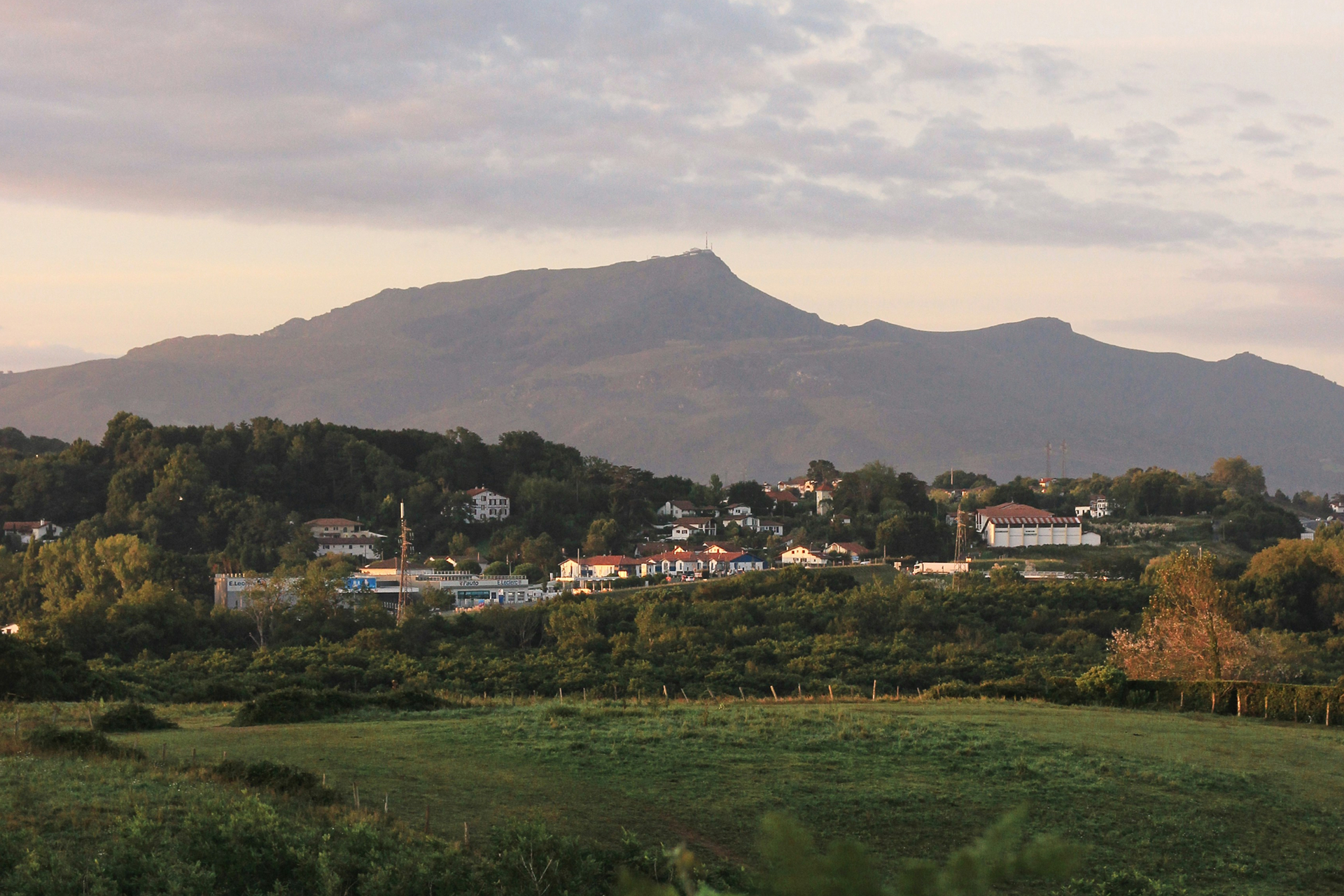
Why Visit La Rhune in 2026
La Rhune is not a high Alpine giant. It tops out at a modest 905 m, hovering above the Atlantic like a green-backed dragon, straddling the French–Spanish border between Saint-Jean-de-Luz, Ascain, Sare, and the first folds of Navarre. But if you think height is everything, La Rhune will gently prove you wrong.
I’ve been coming here for over a decade—long weekends in spring to chase wildflowers, stormy November walks when the wind smells of salt and sheep, and lazy August days riding the toy-like rack railway with my nephews. It’s one of those mountains that feels deeply lived-in: dotted with pottok ponies, sheep, and stone cromlechs, crowned by a 1920s cogwheel train, and wrapped in the sound of cowbells and Basque spoken on both sides of the frontier.
La Rhune is perfect if you want:
- Accessible hiking with big ocean panoramas but without brutal altitude or technical terrain.
- Family-friendly adventures: a historic rack railway, gentle summit paths, and villages built for strolling and snacking.
- Cultural depth: Basque cuisine, pelota courts, frontons, and stone farmhouses that still feel genuinely rural.
- Romantic escapes: sunset from the ridgeline, slow dinners in farmhouse restaurants, and sea-meets-mountain vistas.
- Soft adventure: trail running, long ridge hikes, cross-border walks into Spain, and occasional paragliders wheeling above the valley.
This 2026 travel guide is written as if you were planning a serious trip—4, 5, 6, or 7 days in La Rhune and its surrounding valleys and villages. You’ll find a detailed 4–7 day itinerary for La Rhune, in-depth portraits of the main peaks, passes, valleys, and base villages, plus practical travel tips for La Rhune covering transport, gear, mountain safety, and money-saving tricks.
La Rhune & The Region: An Overview
La Rhune (Larrun in Basque) rises directly behind the coast, a green whale-backed summit with a radar dome and a string of antennas on top. From the summit you see the silver slash of the Atlantic, from Bayonne to beyond San Sebastián, and inland the folds of the Pyrenees rolling away into Navarre.
Unlike Alpine resorts where villages were built around ski lifts, La Rhune’s base villages—Ascain, Sare, Saint-Pée-sur-Nivelle, Urrugne, and the coastal Saint-Jean-de-Luz—were here long before tourism. That gives the area its charm: you’re not in a ski factory, but in lived-in Basque communities where the fronton is as important as the church.
Altitude & terrain: 905 m at the summit, with rolling ridgelines, steep but manageable hiking trails, and low passes that stay mostly snow-free except in short winter spells. No glaciers, no technical mountaineering; this is a mountain for walkers, trail runners, and families rather than ice climbers.
Best bases by season:
- Spring (March–May): Ascain or Sare for direct access to hiking trails, with Saint-Jean-de-Luz for sea breezes and shoulder-season calm.
- Summer (June–August): Saint-Jean-de-Luz for beaches + mountain day trips; Sare for quieter rural stays.
- Autumn (September–November): Ascain for crisp hiking days and chestnut forests, Urrugne for cross-border hikes.
- Winter (December–February): Not a ski destination; choose Saint-Jean-de-Luz for coastal walks and the odd clear-day ascent of La Rhune.
Itineraries: 4–7 Days in La Rhune
Below are overlapping itineraries. If you’re planning 4 days in La Rhune, focus on Days 1–4. For a 5 day itinerary for La Rhune, add Day 5; and so on up to a full 7 day itinerary for La Rhune. I’ve woven in my own recent visits (spring and autumn 2025) to keep it grounded in current reality.
4 Day Itinerary for La Rhune: Essentials of Mountain & Sea
Day 1 – Ascain, The Rack Railway & First Taste of La Rhune
I always tell first-timers: start in Ascain. It’s the classic base village—white-and-red Basque houses, shady plane trees around the fronton, and La Rhune looming like a promise behind the church spire.
Morning: Arrive & settle in Ascain
- Check into a chambre d’hôtes or small hotel near the river. I like staying within a 5–10 minute walk of the square so evenings are easy.
- Grab a coffee and gâteau basque at a local bakery. Ask for one filled with black cherry for a very Basque start.
Late morning: La Rhune rack railway (Petit Train de la Rhune)
The Petit Train de la Rhune is not a gimmick; it’s a genuine 1920s rack railway that clanks slowly up from the Col de Saint-Ignace (10 minutes’ drive from Ascain) to just below the summit. In 2025 they refurbished some carriages and for 2026 they plan slightly extended operating dates into late October, weather permitting.
- How to get there: From Ascain, either drive (large pay car park) or take the seasonal shuttle bus (check 2026 timetables at the Ascain tourist office).
- Tickets: Book online in high season (July–August and weekends) to avoid sold-out trains. Round-trip or one-way (up by train, down on foot) are possible.
On my last visit, I took the first train of the day in late September. Mist still clung to the lower slopes, but we broke through into sun around half-height, with pottok ponies silhouetted above a sea of cloud. That’s La Rhune at her most magical.
At the top:
- Walk the last few minutes to the summit platform.
- Circle the top on the easy trail, pausing at viewpoints over Spain and the French coast.
- Have a simple lunch at one of the ventas (rustic eateries) on the Spanish side: chipirons (baby squid), omelette aux piments, or a hearty plate of axoa (Basque veal stew).
Afternoon: Hike down or train down
If you’re reasonably fit and weather is good, I strongly recommend hiking down to Ascain (around 2.5–3.5 hours, steep in parts but non-technical). Otherwise, take the train back and visit the nearby villages.
Evening: Apéro in Ascain
- Order a glass of txakoli (slightly sparkling Basque white wine) or local cider on a terrace.
- Dinner at a traditional inn—look for piperade, axoa, or grilled trout from the Nivelle river.
Day 2 – Sare, Caves & Cross-Border Vistas
Sare is one of my favourite villages in France, and it’s officially classified among the “Plus Beaux Villages”. The square is framed by big Basque houses, the church tower is squat and solid, and there’s a sleepy dignity even in August.
Morning: Stroll Sare & its heritage
- Walk the heritage trail through the village, reading about Basque architecture (look for the dates and names above the doors).
- Pop into the church; if the balcony is open, you’ll see the typical Basque layout with galleries around the nave.
Late morning: Sare Caves (Grottes de Sare)
A short drive or bus ride from Sare, the Grottes de Sare offer a cool, atmospheric contrast to the open slopes of La Rhune. Guided tours explain prehistoric occupation and the mythology of the mountain. Even after several visits, I still enjoy the play of light and the echo of footsteps inside.
- Bring a light layer; it’s cool year-round inside.
- Combine with the surrounding interpretation trail on Basque mythology and pastoralism.
Afternoon: Short hike towards La Rhune
From Sare, there are quieter trails heading onto the lower flanks of La Rhune, away from the rack railway crowds. I like the loop via Erlaiza, where you’ll often see more sheep than people.
Evening: Farmhouse dinner
Reserve a ferme auberge (farm inn) around Sare or Ascain for dinner. One of my best meals in 2025 was in a converted barn: slices of xistorra sausage, grilled lamb, and a simple flan made with farm eggs. In this region, the shorter the menu, the better the meal tends to be.
Day 3 – Saint-Jean-de-Luz: Sea, History & Basque Flavours
Spending 4 days in La Rhune without visiting the sea would be a mistake. Saint-Jean-de-Luz is the natural coastal counterpoint: a perfect half-moon bay, old corsair houses, and the faint outline of La Rhune behind the harbour.
Morning: Old town & harbour
- Wander the old streets—Rue Gambetta is touristy but pretty—then duck down side lanes for calmer corners.
- Visit the Church of Saint John the Baptist, where Louis XIV married Maria Theresa of Spain.
- Walk the seawall to look back at the town with La Rhune peeking above the roofs.
Lunch: Local food in Saint-Jean-de-Luz
For lunch, I like simple tapas-style plates near the harbour: grilled sardines when in season, chipirons, and a glass of cold white. Basque cakes and mouchous (macaron-like almond sweets) are mandatory.
Afternoon: Beach & relaxed time
- Swim if weather allows; the bay is sheltered and family-friendly.
- Or, take a coastal walk towards Socoa for views back to La Rhune and the cliffs.
Evening: Back to Ascain or stay by the sea
If you’re on a 4 day itinerary, I’d stay based in Ascain throughout for simplicity. But couples on a romantic trip might choose to spend this night in a sea-view room, then return inland the next morning.
Day 4 – The Classic Ascent & Ridge Walk
Your final day should belong entirely to the mountain. Whether you’ve ridden the train already or not, today I suggest a full ascent on foot from Ascain or the Col de Saint-Ignace.
Morning: Early start from Ascain
- Set off by 8:00–8:30 in summer to avoid the heat. The path climbs steadily through pasture and heath.
- Watch for pottok ponies (semi-wild Basque ponies) and stone circles; this is a landscape marked by centuries of transhumance.
Summit experience
Even if you’ve been up by train, arriving on foot feels different: you’ve earned the panorama. On a clear day you can trace the coastline from the Landes dunes in the north down to the Spanish flysch cliffs. Inland, the Pyrenees step away in blue ridges.
Afternoon: Ridge extension (for the energetic)
If you’re comfortable with a longer day, continue along the border ridge towards Peña Plata and the Col des Trois Fontaines, then loop back down to Ascain. It’s one of the most satisfying moderate hikes in the region.
Evening: Farewell dinner
Celebrate with a final Basque dinner: maybe axoa again, or a plate of fromages de brebis (sheep’s cheeses) with black cherry jam. If the sky is clear, step outside after dark—away from the village lights—and look up. The stars above La Rhune can be startlingly bright after a coastal storm has scrubbed the air clean.
5 Day Itinerary for La Rhune: Adding Depth & Hidden Gems
With 5 days in La Rhune, you can slow down and add one of my favourite under-the-radar valleys.
Day 5 – Saint-Pée-sur-Nivelle & The Nivelle Valley
Saint-Pée-sur-Nivelle (Senpere in Basque) sits in a dreamy valley north of La Rhune, wrapped around a lake that locals love in summer. It’s less famous than Ascain or Sare, which is exactly why I like it.
Morning: Nivelle lake loop
- Walk or jog the loop around the lake (easy, family-friendly, with picnic spots and playgrounds).
- In summer, there’s supervised swimming and paddle rentals—great for kids.
Lunch: Picnic or lakeside café
Pick up bread, cheese, cured ham, and fruit in the village, then picnic by the shore. The view back towards La Rhune over the water is surprisingly grand for such a modest altitude.
Afternoon: Valley walks & farm visits
Spend the afternoon exploring the Nivelle valley on foot or by bike. On my last trip, I followed quiet backroads up to a small farm that sold raw sheep’s milk cheese from a fridge with an honesty box. These are the small moments that make a trip to La Rhune feel personal.
Evening: Return to base & slow night
By now, your days have been full. Take tonight gently—perhaps a glass of red Irouléguy wine and a shared plate of charcuterie, then bed early for the longer ridgeline adventures that a 6 or 7 day stay allows.
6 Day Itinerary for La Rhune: Longer Ridges & Cross-Border Flavour
With 6 days in La Rhune, you can step further into the border ridges and neighbouring Spanish valleys.
Day 6 – Urrugne & The Western Slopes
Urrugne lies slightly west, between La Rhune and the ocean, with quieter access points to the mountain and generous valley views.
Morning: Village and chapel
- Visit the old centre and the Chapelle de Socorri, perched on a hill with a far-reaching panorama.
- From here, La Rhune appears almost sculptural—its silhouette is different from this angle, layered behind rolling pasture.
Afternoon: Western flank hike
From trailheads above Urrugne, you can access the western routes of La Rhune, less frequented than the classic Ascain ascent. I like the loop that climbs up via old smugglers’ paths, crossing into Spain briefly before rejoining the main ridge.
Evening: Tapas on the Spanish side (optional)
If you have a car and don’t mind a late night, dip over the border to Hondarribia or Irun for pintxos before returning. It’s a reminder of how porous and shared this mountain landscape is.
7 Day Itinerary for La Rhune: A Full Week of Mountain Life
Spending 7 days in La Rhune lets you settle into a rhythm: hike, eat, rest, repeat. For your final day, I recommend a quieter, contemplative corner of the massif.
Day 7 – The Cols & Hidden Pastures
Morning: Col de Saint-Ignace & nearby cromlechs
Instead of heading straight up, spend time exploring the lower passes and stone circles near the Col de Saint-Ignace. When I walked here one misty January afternoon, the cromlechs appeared and disappeared in the cloud like ghostly watchmen.
Afternoon: Gentle loop & picnic
Follow one of the signed family loops that stays on the lower slopes. Pack a picnic and choose a rock with a view for a long, lazy lunch. After a week of big scenery, this softer landscape of bracken and heather is a balm.
Evening: Last light on La Rhune
End your 7 day itinerary for La Rhune by simply sitting somewhere with a clear view of the mountain at dusk—be it a terrace in Ascain, a field edge near Sare, or the riverbank in Saint-Pée. Watch how the light slides off the flanks, and you’ll see why locals talk about La Rhune with genuine affection.
Peaks, Valleys, Passes & Villages: 15 Places to Know
La Rhune isn’t just a single summit; it’s a small world of ridges, cols, and valleys, studded with villages that make ideal bases. Below are 15 detailed portraits of the most important spots—peaks, passes, valleys, and towns—to help you plan where to hike, where to stay, and what to eat.
1. La Rhune Summit (905 m)
Altitude: 905 m • Best for: Hiking, panoramic views, family-friendly summit experience • Accessibility: Rack railway + short walk, or hiking trails from Ascain, Sare, Urrugne, and Col de Saint-Ignace.
The summit itself is a curious mix of wild and busy: pottok ponies grazing next to antenna masts, ventas frying calamari, hikers and families jostling for space along the low walls. I’ve been here in all seasons—sweating in August, braced against a January wind, and wrapped in mist in April. Each mood has its charm.
History & significance: For centuries, La Rhune was a smuggling route and a sacred mountain for local shepherds. The rack railway, built in the 1920s, made it a mass tourism icon, but the underlying pastoral rhythm remains: you still hear bells and see shepherds working the slopes.
Tips:
- In peak season, take the first or last train of the day for fewer crowds and softer light.
- If hiking, carry windproof layers even in summer; the summit can be breezy and cooler than the valley.
- For photos, walk beyond the main terrace along the border path; the crowds thin out quickly.
Best base: Ascain or Sare in most seasons; Saint-Jean-de-Luz if you want to mix daily life with the sea.
2. Peña Plata & The Southern Ridge
Altitude: ~700–800 m • Best for: Ridge hiking, quieter trails, cross-border loops • Accessibility: On foot from the La Rhune summit or from Spanish trailheads.
Where the tourist crowds thin out, the real mountain begins. The ridge running south from La Rhune towards Peña Plata is my favourite place on a clear autumn day. You feel the tug of Spain more strongly here: the language flips, the ventas turn to sidrerías, and the horizon opens onto Navarre.
Personal note: On a blustery November day in 2024, I walked this ridge alone, watched by griffon vultures circling lazily overhead. I’d packed a thermos of coffee and a hunk of cheese, and I remember thinking that no fancy viewpoint could beat this simple perch.
Best base: Sare or Ascain if you’re approaching from the French side; Spanish villages just over the border for multi-day ridge walks.
3. Col de Saint-Ignace (Pass, ~169 m)
Altitude: ~169 m • Best for: Starting point for the rack railway and family hikes • Accessibility: Road access, car park, seasonal bus from Ascain.
The Col de Saint-Ignace is the practical heart of La Rhune tourism: this is where the rack railway departs, and where many shorter walks begin. It’s not a dramatic high pass, but its low altitude means it’s accessible almost year-round.
Tips:
- Use it as a base for gentle loops on the lower flanks if you’re travelling with small children or older relatives.
- Arrive 30–40 minutes before your train to park, collect tickets, and use facilities.
Best base: Ascain (10-minute drive) or Sare.
4. Nivelle Valley & Saint-Pée-sur-Nivelle
Altitude: 20–200 m • Best for: Easy walking, lake swims, cycling, family days • Accessibility: Road access, limited buses from Saint-Jean-de-Luz and Ascain.
The Nivelle valley is softer than the immediate slopes of La Rhune—fields, hedgerows, and the slow curl of the river. It’s where I go when I’ve had enough of steep paths and want to wander instead.
Highlights:
- Saint-Pée-sur-Nivelle lake for summer swimming and picnics.
- Backroad cycling between farms selling cheese and honey.
- Autumn colours in the low woods and hedgerows.
Best base: Saint-Pée itself if you want a very quiet stay, or Ascain with day-trips into the valley.
5. Ascain (Village Base)
Altitude: ~30 m • Best for: Central base village, easy access to trails and rack railway • Accessibility: Road connections to Saint-Jean-de-Luz and surrounding villages; limited buses.
Ascain is where I usually stay when I come to write or hike around La Rhune. The houses are classic Basque white with red timbers, the fronton is always ready for a spontaneous game of pelota, and there are just enough cafés and restaurants to keep evenings interesting without tipping into resort territory.
Why base here:
- Short drive or shuttle to the rack railway.
- Direct hiking trailheads to La Rhune from the village edge.
- Good spread of mid-range places to stay and eat.
Seasonal note: In 2026, Ascain is planning more small-scale cultural events (music on the square, local produce markets) in shoulder season to spread tourism more evenly beyond July–August.
6. Sare (Plus Beau Village)
Altitude: ~60 m • Best for: Heritage, caves, quiet rural base • Accessibility: Road, regional buses from Saint-Jean-de-Luz and Bayonne (infrequent).
Sare’s beauty is almost cinematic, but it wears it lightly. I like to arrive mid-morning when the bakery smells seep into the square and older locals settle into cafés for the day’s first gossip.
Stay here if:
- You value calm over nightlife.
- You want to combine La Rhune with caves, museum visits, and gentle countryside walks.
Food tip: Some of the best gâteau basque I’ve eaten came from a tiny bakery just off the main square in Sare. Ask locals which one they favour; opinions are strong, and the debate is part of the fun.
7. Saint-Jean-de-Luz (Coastal Base)
Altitude: Sea level • Best for: Combining beach with mountain day trips, couples and families • Accessibility: Train from Bayonne and Hendaye; buses inland.
Strictly speaking, Saint-Jean-de-Luz is not part of La Rhune, but the mountain backdrops almost every view, and many people choose to stay here and day-trip up. For a romantic break, this is hard to beat: sea breezes, excellent restaurants, and that ever-present profile of La Rhune reminding you that tomorrow you might swap sand for heather.
Best base in: Summer, if you’re happy to drive or bus inland for hikes and return to the beach each afternoon.
8. Urrugne & Socorri Heights
Altitude: 20–300 m • Best for: Western views of La Rhune, quiet lanes, chapels with panoramas • Accessibility: Road from Saint-Jean-de-Luz and Hendaye.
Urrugne is a working village with a dramatic skyline: cliffs towards the coast, La Rhune behind, and the tiny Chapelle de Socorri perched above it all.
My routine here: Drive or hike up to the chapel late afternoon, bring a thermos or a simple picnic, and watch the light fall across both sea and mountain. In 2025, I watched a local family arrive with guitars and snacks; they played soft songs in Basque as the sun dipped. That’s Urrugne: unshowy, quietly magical.
9. Col des Trois Fontaines & Smugglers’ Trails
Altitude: ~600 m • Best for: Moderate ridge walking, cross-border history • Accessibility: On foot from the main La Rhune ascent or Spanish side trails.
This modest col is etched with stories. Smugglers once carried contraband across by night, dodging customs officers. Today, hikers follow their paths in broad daylight, but if you come on a misty day, you can still feel a hint of that quiet tension.
Tip: Combine with a loop that descends into Spain for lunch at a venta, then returns via a different col. Carry ID; the border is open, but it’s sensible.
10. Ascain Ridge & Lower Slopes
Altitude: 100–600 m • Best for: Half-day hikes, trail running, spring wildflowers • Accessibility: Directly from Ascain.
The lower ridges above Ascain are where local runners train and families take Sunday walks. In April and May, the slopes are freckled with wildflowers—yellow broom, purple heather, and tiny orchids if you have an eye for them.
Ideal for: A first acclimatisation walk on your arrival day, or a leg-stretcher before a long drive home.
11. Grottes de Sare & Surrounding Hills
Altitude: 100–400 m • Best for: Cave visits, mythology, gentle hills • Accessibility: Short drive from Sare.
A visit to the Grottes de Sare is more than a cave tour; it’s a window into how deeply human history and the landscape interweave. The surrounding hills, dotted with dolmens and cromlechs, feel quieter than the main La Rhune axis.
Tip: Combine the cave tour with the mythology trail above; panels explain Basque legends of witches, lamias, and the spirits that supposedly haunt these valleys.
12. Saint-Pée-sur-Nivelle Lake
Altitude: ~40 m • Best for: Family swimming, picnics, easy cycling • Accessibility: Road, parking at the lakeside.
Come here on a hot summer day when the slopes of La Rhune shimmer. The lake is ringed with grass, playgrounds, and simple cafés. It’s not wilderness, but it’s ideal if you’ve promised the kids a “no hiking” day.
Season: Lifeguarded in high season only; outside those dates, swim at your own risk.
13. The Franco-Spanish Border Ridge
Altitude: 600–900 m • Best for: Full-day hikes, history, wide views • Accessibility: On foot from La Rhune summit or various cols.
Running along the crest, the border ridge is a line of stone markers, weathered by storms and generations. On one side, French Basque Country; on the other, Spanish. But up here, the distinction feels faint: same sheep, same ponies, same wind.
Best in: Clear spring or autumn weather, when the visibility is sharp and temperatures mild.
14. Isolated Basque Farmsteads & Pastures
Altitude: 100–500 m • Best for: Cultural walks, photography, understanding local life • Accessibility: Walking from any of the base villages along backroads and paths.
The soul of La Rhune is in its farmsteads: white houses with deep-sloping roofs, woodpiles stacked meticulously, and small pastures divided by living hedges. When I have a spare afternoon, I’ll simply follow a minor lane uphill and see where it goes, greeting farmers with a Egun on (good morning in Basque) as I pass.
Etiquette: Always respect private property—if a gate is closed, don’t open it unless it’s clearly marked as a public right-of-way. If a trail crosses a pasture, close gates behind you.
15. Coastal Cliffs Between Socoa & Hendaye (La Corniche Basque)
Altitude: Sea level to ~50 m • Best for: Sea-meets-mountain vistas, easy walks, sunset views • Accessibility: Roadside parking and paths along the coast between Socoa and Hendaye.
While not part of La Rhune’s massif, the Corniche Basque offers some of the best “postcard” views of the mountain rising behind the sea. On a clear day, the outline of La Rhune is crisp against the inland sky.
Tip: Come for sunset, then look inland as the last light hits the summit, turning it briefly gold before dusk.
Mountain Dining Around La Rhune
La Rhune doesn’t have Alpine-style rifugios perched at 2,500 m, but it does have a rich network of ventas, farm inns, and village restaurants that give mountain days their flavour.
Ventas & Summit Eateries
On the summit and the Spanish flank, you’ll find simple ventas serving grilled meats, fried squid, tortilla de patatas, and hearty stews.
- Expect rustic, filling food, often at better value than down on the French side.
- Cash is still handy, though most now accept cards.
Farm Inns & Rural Restaurants
Look for signs to ferme auberge around Sare, Ascain, and Saint-Pée: these are working farms that serve meals based largely on their own produce.
Typical dishes:
- Axoa – finely chopped veal or beef in a pepper sauce.
- Truite de la Nivelle – local river trout, often grilled with almonds.
- Fromage de brebis – sheep’s cheese served with black cherry jam.
- Gâteau basque – almond or custard-filled cake, crisp outside, soft inside.
Coffee, Pastries & Cake Culture
Every hiking day in La Rhune should start (or end) with coffee and something sweet. In Ascain and Sare, you’ll find bakeries where locals line up early for bread; slip in after the rush for a slower coffee and cake.
Personal favourite ritual: After a long hike, I’ll sit with an espresso and a slice of gâteau basque, watching the mountain I just climbed recede into evening light.
Where to Stay: Village vs. Slope-Side vs. Rural
- Village (Ascain, Sare): Best for a first visit; you can walk to dinner, and trailheads are close.
- Coastal town (Saint-Jean-de-Luz): Ideal if you want sea and mountain together, with good public transport.
- Rural gîte or farmhouse: Perfect for longer stays, cooking your own meals, and true quiet nights.
Saving Money on Food in a High-Cost Region
- Lunch menus: Seek out menu du jour at midday; they’re often excellent value.
- Picnics: Buy cheese, bread, fruit, and cured meats at village shops and picnic on the slopes.
- Self-catering: If staying a week, a place with a small kitchen can cut costs significantly.
Evenings in La Rhune
Evenings in La Rhune are quieter than in big Alpine resorts, but that’s part of the charm.
Après-Hike Traditions
Instead of a raucous après-ski scene, you’ll find:
- Terraces where locals sip txakoli or cider.
- Frontons where young people play pelota until it’s too dark to see the ball.
- Village squares where kids roam and adults talk.
Bars & Fondue Nights
You won’t find Swiss-style fondue here, but you will find hearty Basque comfort food and wine lists that lean towards Irouléguy and Rioja. In Ascain and Sare, a few bars stay open late on weekends; in Saint-Jean-de-Luz, the nightlife is livelier with wine bars and music.
Stargazing & Night Walks
On clear nights, especially after a storm, step away from village lights. Bring a headlamp and walk a short way up a local track. The combination of stars and the dark shape of La Rhune is quietly spectacular.
Seasonal Festivals
Throughout the year, villages host small festivals: Basque dance performances, music, and food fairs. In 2026, local councils are coordinating to avoid overlap and create a seasonal calendar; check with tourist offices for up-to-date listings.
Cultural Etiquette & Local Customs
The Basque Country is proudly distinct, with its own language (Euskara), sports, and traditions. Respecting this is key to a good stay.
Language
- French is widely spoken on the French side; Spanish on the Spanish.
- Basque is present in signage and daily life; learning a few words (like Egun on – good morning, Eskerrik asko – thank you) is appreciated.
Greetings & Behaviour
- Say bonjour when entering shops and cafés.
- On trails, a simple nod or bonjour/kaixo is friendly.
- Respect siesta hours in smaller villages; some places close early afternoon.
Religious & Festive Life
Church festivals, processions, and saints’ days are taken seriously. If you stumble upon one, observe respectfully and follow locals’ lead.
Farm & Pasture Etiquette
- Always close gates behind you.
- Keep dogs on a leash near livestock.
- Don’t walk through farmyards unless a marked trail clearly does so.
What’s New in 2026–2027: Events & Changes
While La Rhune remains largely unchanged in spirit, there are a few noteworthy developments for 2026–2027:
- Petit Train de la Rhune schedule extension (2026): Subject to weather, the season extends slightly deeper into October to catch late autumn hikers.
- Trail maintenance program: Local communes are improving waymarking on less-used routes from Urrugne and Saint-Pée; expect clearer signage and better drainage in muddy sections.
- Cultural festivals: A coordinated “Semaine de La Rhune” week in early September 2026 will feature hikes, storytelling evenings about smugglers and shepherds, and Basque music in Ascain and Sare.
- Eco-transport push: Pilot shuttle services from Saint-Jean-de-Luz to Ascain and Col de Saint-Ignace on summer weekends to reduce car traffic.
Day Trips & Nearby Attractions
La Rhune is a perfect hub for day-trips across the Basque Country.
Bayonne & Biarritz
Distance: ~45–60 minutes by car from Ascain.
- Bayonne: Cathedral, chocolate shops, and old ramparts.
- Biarritz: Surf, the Rocher de la Vierge, and a more glamorous seaside feel.
Hondarribia & San Sebastián (Spain)
Distance: ~40–60 minutes from Ascain to Hondarribia; ~1.5 hours to San Sebastián.
Ideal for pintxos crawls, harbour walks, and a taste of Spanish Basque culture. Cross-border buses and trains make this easy if you prefer not to drive.
Inland Basque Villages (Espelette, Ainhoa)
Espelette, famous for its red peppers, and Ainhoa, another “Plus Beau Village”, are classic postcard stops. They combine well with a La Rhune-based trip for a deeper Basque immersion.
Practical Travel Advice for La Rhune
How to Get There
- By air: Biarritz Pays Basque Airport is the closest (about 30–45 minutes by car to Ascain).
- By train: TGV and regional trains to Saint-Jean-de-Luz or Bayonne, then buses or taxis inland.
- By car: A car offers the most flexibility for exploring multiple valleys and trailheads.
Getting Around
- Public transport: Functional but limited inland; fine if you base in Saint-Jean-de-Luz and accept some constraints.
- Car rental: Available at Biarritz and major towns; book ahead in July–August.
- Foreign driving licences: Most non-EU licences are accepted for short stays; check current French regulations if staying long-term.
SIM Cards & Connectivity
- eSIMs and local SIMs: French providers (Orange, SFR, Bouygues) offer tourist-friendly plans; buy at airports or in Bayonne/Biarritz.
- Reception on La Rhune is generally good near the summit, patchier in some valleys.
Visas & Entry
- La Rhune is in France (Schengen Zone). Check if you need a Schengen visa based on your nationality.
- For cross-border hikes into Spain, no border checks in practice, but carry passport or ID card.
Budget & Money-Saving Tips
- Stay in a gîte or self-catering apartment if you’re here a week.
- Use picnics for lunches on hiking days.
- Visit in shoulder seasons (May–June, September–October) for lower prices and quieter trails.
Best Seasons & What They’re Good For
- Spring (March–May): Wildflowers, fresh green slopes, cooler hiking temperatures.
- Summer (June–August): Warm, sometimes hot; ideal for combining sea and mountains but busier.
- Autumn (September–November): My personal favourite—stable weather, golden light, fewer crowds.
- Winter (December–February): Not a ski area; occasional snow, moody storms, good for quiet walks and coastal days.
Mountain Logistics & Safety
Altitude & Acclimatisation
At 905 m, altitude sickness is not an issue at La Rhune. The main challenges are weather, footing, and fitness.
Weather, Storms & Seasonal Closures
- Storms: Atlantic systems roll in fast; check forecasts and avoid exposed ridges in thunderstorms.
- Snow & ice: Rare but possible in winter; trails can be slippery even with light snow.
- Rack railway: Does not run in strong winds or storms; always check before heading to the Col de Saint-Ignace.
Avalanche Risk
La Rhune does not have typical high alpine avalanche terrain, but in exceptional snow years, avoid steep, loaded slopes and stick to well-trodden paths or postpone hikes.
Gear & Clothing
- Footwear: Sturdy hiking shoes or boots with good grip; trails can be rocky and muddy.
- Layers: Even in summer, carry a light fleece and windproof jacket.
- Rain protection: A waterproof shell or poncho—Atlantic showers can be sudden.
- Crampons/microspikes: Only useful in rare icy winter conditions; not needed for typical visits.
Mountain Rescue & Insurance
- In France, dial 112 for emergencies.
- Consider travel insurance that covers hiking and mountain rescue, especially if doing longer ridge walks.
Cable Cars, Trains & Lift-Pass Strategy
There’s just one main uplift: the Petit Train de la Rhune. No complex lift-pass strategy needed; simply decide whether to hike, ride, or combine both.
Best Seasons for Specific Activities
- Hiking: April–June, September–November.
- Wildflowers: April–May.
- Fall colours: Late October–early November in the lower woods and valleys.
- Sea + mountain combo: June–September, with shoulder seasons for fewer crowds.
Summary & Final Recommendations
La Rhune is a modest mountain with an outsized presence. It’s where sea air meets Pyrenean slopes, where Basque farm life rubs shoulders with gentle tourism, and where you can hike a real summit in the morning and swim in the Atlantic by afternoon.
If you’re planning a 4 day itinerary for La Rhune, base in Ascain, ride the rack railway once, hike the summit at least once, visit Sare and Saint-Jean-de-Luz, and eat as locally as possible. With 5, 6, or 7 days in La Rhune, add the Nivelle valley, Urrugne’s western trails, and long days on the border ridge.
Best overall seasons: May–June and September–October, when the light is kind, the crowds thinner, and the mountain feels most like herself.
The real joy of La Rhune isn’t ticking off “must-see attractions” but slipping into its daily rhythm: morning mist lifting off the slopes, pottok ponies against the sky, the thwack of a pelota ball on the fronton, and the simple pleasure of looking up each evening to see the mountain changing colour. Plan your days well, respect the land and its people, and La Rhune will reward you with more than just pretty views—it will give you a sense of belonging, if only for a while.