Why Visit Praiano: The Amalfi Coast Village That Stays With You
If the Amalfi Coast were a symphony, Positano would be the dramatic crescendo and Amalfi the bold brass section. Praiano is the quiet, intricate melody that stays in your head long after the music ends.
I first came to Praiano in my early twenties, chasing the same Instagram-perfect Positano shots that everyone else was. The bus dropped me here by accident (I’d misread the stop), and within an hour I’d decided to stay. Since then, I’ve returned almost every year—sometimes for work, sometimes to write, sometimes just to breathe.
Praiano is special because it’s still, in many ways, a real village. You’ll see nonnas gossiping from balconies, fishermen tinkering with their boats at dawn, and kids playing football in tiny piazzas. The sunsets are outrageous, the steps are brutal (you will earn every gelato), and the sea feels like it belongs to you.
This 2026 travel guide to Praiano is the one I wish I’d had the first time: not just a list of things to do in Praiano, but a lived-in, deeply personal travel story with practical details, honest advice, and long-form descriptions of the main 20 attractions, plus complete 3, 4, and 5 day itineraries.
Praiano in 2026: A Calm Corner of the Amalfi Coast
In 2026, Praiano remains one of the best places to base yourself on the Amalfi Coast if you want balance: close enough to Positano and Amalfi to enjoy their buzz, far enough to sleep without traffic horns and party noise. Tourism has grown, but the village has resisted turning into a theme park.
Expect a stair-filled, vertical village wrapped around the cliffs, with two main beach areas—Marina di Praia and Gavitella—plus dozens of narrow lanes linking family-run guesthouses, small hotels, and trattorie. Buses are still crowded in peak summer, but new 2025–2026 schedules have improved frequency in shoulder seasons, making spring and autumn even more attractive.
Neighborhoods & Areas of Praiano
Vettica Maggiore (Upper Praiano)
This is where I usually stay. It’s the heart of “upper” Praiano: whitewashed houses clinging to the hillside, balconies overflowing with geraniums, and the main church of San Gennaro watching over everything. The views of Positano from here are some of the most cinematic on the coast.
Vettica Maggiore is ideal if you want classic Amalfi Coast terraces, easy access to cafés, and those legendary sunsets. You’ll walk plenty of stairs down to Gavitella beach, but that’s part of the rhythm of staying here.
Marina di Praia (The Cove)
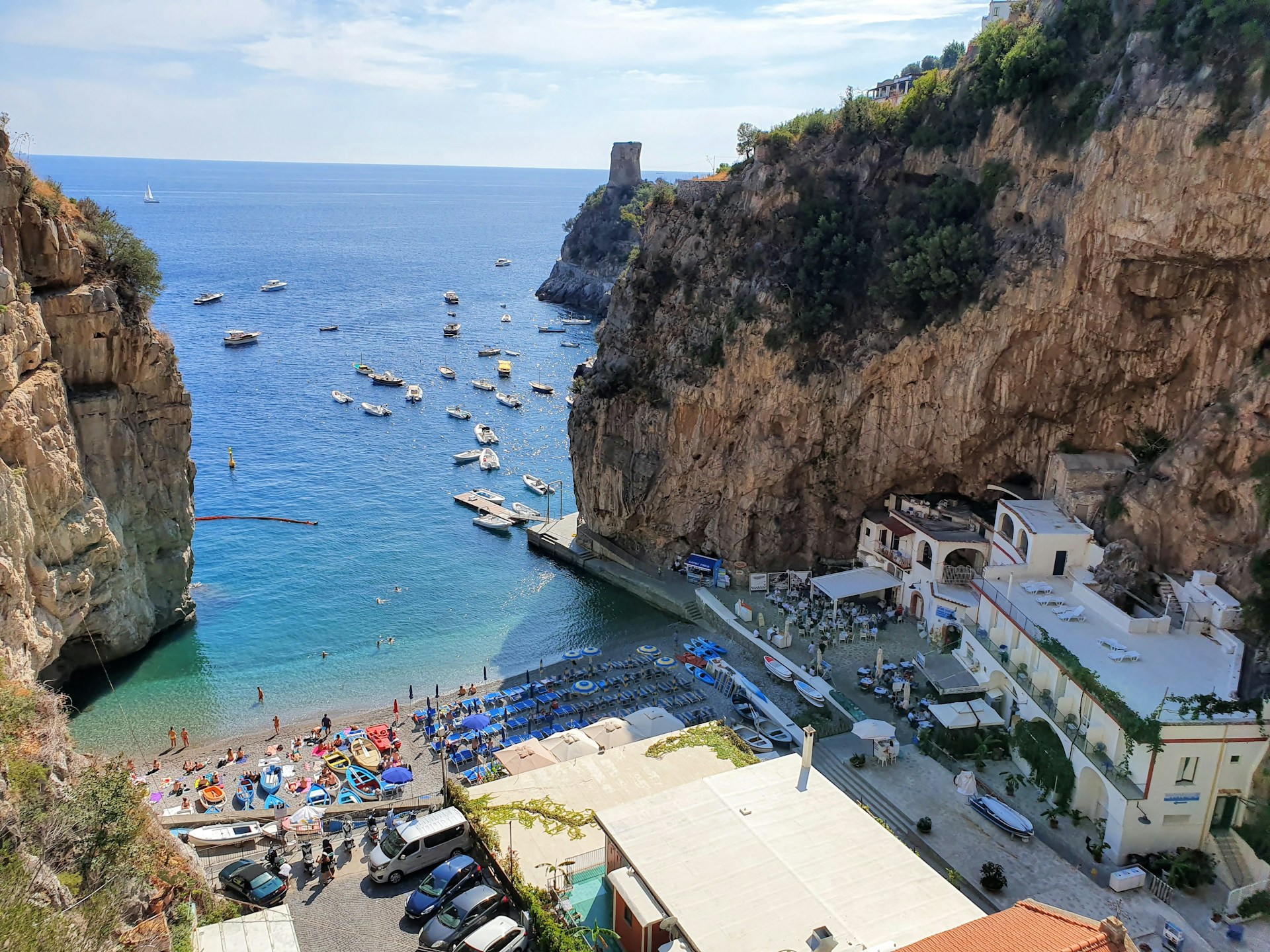
Marina di Praia is a tiny fjord-like inlet tucked between steep cliffs. This is the working soul of Praiano’s relationship with the sea: boat rentals, fishermen, and old stone watchtowers. It’s busier now than it was a decade ago, but early mornings are still wonderfully quiet.
Gavitella Area
The area around the stairway to Cala della Gavitella is a tangle of lemon groves, small apartments, and hidden terraces. It’s quieter than the more central stretches of the Amalfi Coast and gets long hours of sun—unusual here, where many beaches lose the light early.
San Luca & Eastern Praiano
Closer to the Amalfi side, the San Luca area feels more residential. Prices for accommodation can be a bit lower, and you’ll find more everyday local life: a hardware store, older bars, and small groceries where everyone seems to know each other.
20 Must-See Attractions & Hidden Gems in Praiano
These are the places I return to on every trip—the spots where I’ve watched storms roll in, eaten too much seafood, and fallen a little more in love with Praiano. For each, I’ll share history, significance, how to get there, and my own experiences.
1. Chiesa di San Gennaro & Piazza (Vettica Maggiore)
The tiled dome of Chiesa di San Gennaro is Praiano’s calling card. It’s the church you’ve seen in photos: bright yellow and green majolica tiles glittering above a square that spills out toward the sea.
The current church dates mainly from the 16th century, though earlier versions probably existed. Inside, it’s all soft light, baroque altars, and the faint smell of incense. I like to slip in during the late afternoon, when the last rays of sun turn the marble pink and the village hum outside briefly fades.
What I do here: I usually start my Praiano days with a coffee in the piazza, watching locals drift in and out of the church, kids on scooters weaving around café tables. On summer evenings, concerts sometimes take place here, and in 2026 the municipality plans more small-scale cultural events: jazz nights, traditional music, and film screenings.
Tips: Dress modestly if you’re going inside (covered shoulders, no beachwear). Come at sunset with a takeaway aperitivo—this piazza is one of the best free-view “terraces” on the coast.
2. Marina di Praia Beach & Fishing Cove
Marina di Praia is a narrow pebbled beach squeezed between cliffs, with a small cluster of restaurants, boat rentals, and an old watchtower. Historically, it was Praiano’s working harbor; today it’s equal parts fishing cove, sunbathing spot, and departure point for coastal boat trips.
I’ve seen Marina di Praia in all moods: mirror-flat seas at 7 a.m., August chaos with every inch of pebble occupied, and October storms sending spray up over the promenade. The best time, in my opinion, is late May or late September, when the light is soft and the crowds thin.
What to do: Swim off the pebbles, rent a kayak, or take a small boat tour along the coast to hidden coves and sea caves. In 2026, more operators are offering eco-conscious, small-group tours with caps on numbers—book ahead in high season.
Food tip: Grab a simple plate of spaghetti alle vongole or grilled fish at one of the beachside restaurants. Prices are slightly higher than up in the village, but the setting is special.
Getting there: From the main Amalfi–Sorrento road, stairs and a narrow path lead down in about 10–15 minutes. The local SITA buses also stop nearby; ask the driver for “Marina di Praia”. Wear good shoes; the descent is steep.
3. Cala della Gavitella Beach & Sun Decks
Cala della Gavitella is Praiano’s sun worshipper’s sanctuary. Unlike many Amalfi Coast beaches that lose the sun by late afternoon, Gavitella faces west and basks in long golden light with a direct view of Positano and the Li Galli islands.
The first time I went, I underestimated the stairs. You descend what feels like a thousand stone steps through lemon groves and glimpses of sea, your legs starting to protest about halfway down. Then you round a corner and suddenly there it is: turquoise water, carved rock platforms, and an amphitheater of cliffs.
What to expect: A mix of paid sunbeds and a small free area. There’s usually a bar/restaurant operating during the season (roughly May–October, weather dependent). The water is deep and clear—great for confident swimmers.
My ritual: I try to spend at least one late afternoon here every trip. I’ll swim, then nurse an Aperol spritz as the sky shifts through shades of peach and violet. Climbing back up at dusk, you can hear conversations drifting from terraces as the village lights flicker on.
Family note: The stairs make it tricky with very young kids or strollers. For families, Marina di Praia is easier, but older kids who can handle stairs will love jumping off the rocks here.
4. Sentiero degli Dei (Path of the Gods) Access via Praiano
The famous Sentiero degli Dei—Path of the Gods—is one of the most spectacular hikes in Italy, winding high above the coast between Bomerano and Nocelle. Many people start from Agerola, but one of my favorite approaches is from Praiano itself.
From the upper part of Praiano, steep stairways climb up toward the convent of San Domenico and beyond. It’s a serious ascent, but the payoff is a sense of earning your place on the trail—and the views unfolding behind you as the sea drops away.
My experience: I usually start just after sunrise to avoid the heat. I carry at least 1.5–2 liters of water, snacks, and a light jacket. By the time I reach the main Path of the Gods, the morning light is slanting across terraced vineyards and tiny stone shepherd huts. You feel small in the best possible way.
Hiking tips (2026):
- Wear proper shoes; the trail is rocky and can be slippery.
- Check weather—avoid in heavy rain or strong wind.
- In peak summer, start early; midday heat is intense.
- Carry cash; small cafés along the way sometimes don’t take cards.
5. Convento di San Domenico & Terrace
Halfway between sea and sky sits the Convento di San Domenico, a peaceful convent with a simple church and one of the most beautiful terraces in the region. Built in the 16th century, it has long been a spiritual and visual landmark.
I love coming here on days when the coast feels too busy. The climb is demanding, but the reward is silence broken only by bells and birds. The terrace looks down over the entire coastline—boats leaving white trails in the blue, Positano floating in the distance.
What to do: Rest in the courtyard, peek into the small church, and soak in the view. Sometimes there are small art exhibitions or spiritual retreats based here. Respect the quiet; it’s still a religious place.
6. Torre a Mare Watchtower
Along the coastal path from Marina di Praia sits Torre a Mare, one of the old watchtowers that once formed a defensive network against pirate raids. These towers are part of the Amalfi Coast’s lesser-known history—silent witnesses to centuries of trade and conflict.
I usually walk out here in the late afternoon. The path clings to the cliff, with waves crashing below. The tower itself is solid and austere, but the views from around it are anything but: endless sea and a horizon that feels like a promise.
Tip: Wear proper footwear; the path can be uneven. This walk is especially magical on slightly cloudy days, when the light is dramatic.
7. Chiesa di San Luca Evangelista
San Luca is Praiano’s other main church, in the more residential part of town. Dedicated to Saint Luke, it’s less photographed than San Gennaro but just as integral to village life.
Whenever I stop here, I’m usually the only visitor. The square in front is modest but charming, often filled with local kids and older residents sitting on benches. Inside, you’ll find paintings attributed to the Neapolitan school and a sense of lived-in faith.
Why visit: For a more authentic, non-touristy slice of Praiano. If you’re staying on this side of the village, this will likely become part of your daily landscape.
8. Via Terramare & Stairway Lanes
Praiano is a village of stairs. Streets like Via Terramare aren’t “sights” in the conventional sense, but they’re where you really feel the place. Narrow walkways pass under stone arches, between lemon terraces, and past tiny shrines tucked into walls.
I always get gloriously lost here. Once, on a hot June afternoon, I took a wrong turn and ended up being invited by an elderly couple to sit in their yard for a glass of homemade limoncello. We didn’t share much language, but we shared a lot of smiles.
Tip: Accept that you will get turned around. That’s part of the fun. Just remember: sea = down, main road = up. And always bring water.
9. Sunset Terraces & Belvederes
Praiano is arguably the best sunset village on the Amalfi Coast. While Positano turns inward toward the bay, Praiano faces the open west, catching full, lingering sunsets that paint the sky and sea.
Some of my most vivid memories here are of evenings on anonymous stair landings or quiet terraces, watching the last ferries trace silver lines across the water as the sky burns orange. You don’t need to pay for a fancy bar; just find a spot and let the show unfold.
Favorite spots: The piazza at San Gennaro, various small belvederes along the main road, and the upper lanes above Vettica Maggiore. Ask your host for their personal favorite—they’ll usually have strong opinions.
10. Local Beach Clubs & Platforms
Praiano doesn’t have long sandy beaches, but it does have characterful beach clubs perched on rocks and platforms. They’re a core part of summer life here: you rent a sunbed, swim in deep blue water, and linger over long lunches.
Over the years, I’ve spent many lazy days hopping between swim sessions and plates of fried calamari. In 2026, expect dynamic pricing: cheaper in shoulder seasons, more expensive in late July and August. Booking ahead is wise for weekends.
Money-saving tip: If you’re on a budget, use the free sections and just splurge on one or two “beach club” days. Bring your own towel and snacks; nobody will judge.
11. Local Artisan Ceramics & Craft Shops
Praiano doesn’t have the shopping buzz of Positano, but there are a few artisan workshops worth seeking out. Hand-painted ceramics, local limoncello, and small art studios fill tiny spaces along the main road and side lanes.
One rainy afternoon, I ducked into a ceramics shop mostly to escape a sudden downpour and ended up talking for an hour with the owner about how patterns and colors differ between Amalfi Coast villages. I left with a small hand-painted bowl that now lives on my desk, a daily reminder of this place.
Tip: Ask if they can ship home; many can, and it saves you from hand-carrying fragile pieces through the rest of your trip.
12. Local Cultural Center & Seasonal Exhibitions
Praiano’s small cultural spaces host rotating exhibitions of local photography, painting, and sometimes installations celebrating maritime traditions and religious festivals. They’re modest but heartfelt.
I stumbled into one such show about fishing life on the coast, with black-and-white photos from the 1950s. What struck me was how much and how little had changed—the boats looked smaller, but the faces familiar.
2026 note: The town has announced more funding for cultural programming, so expect an expanded calendar of events, especially from May to October.
13. Limoneti & Terraced Gardens
Lemon terraces—limoneti—are the backbone of this landscape. Stone walls, wooden pergolas, and bright yellow lemons hanging like lanterns are everywhere if you pay attention.
Some guesthouses in Praiano back onto these terraces, and waking up to the smell of citrus and earth is one of the quiet luxuries of staying here. In recent years, a few small farms have begun offering tours and tastings; ask your host for up-to-date options in 2026.
14. Hidden Coves & Sea Grottos by Boat
The coastline around Praiano is riddled with small coves and grottos accessible only by boat. While Capri’s Blue Grotto gets the fame (and the crowds), these smaller spots feel more intimate.
One of my best Praiano days was a simple 3-hour boat rental with friends. We packed bread, cheese, tomatoes, and a bottle of wine, then spent the afternoon swimming in hidden inlets, our laughter echoing off stone walls.
How to do it: Head to Marina di Praia and talk to the boat rental stands. You can choose between skippered boat trips or small self-drive boats (no license needed for certain engine sizes in Italy, but always confirm rules). Book in advance June–September.
15. Home-Style Cooking Classes
Cooking with a local is one of the most satisfying cultural experiences in Praiano. There are a few small-scale, home-style cooking classes where you’ll learn to make fresh pasta, simple sauces, and classic Amalfi desserts like delizia al limone.
I took a class with a local family a few years back, and the real joy wasn’t the recipes (though they were excellent) but the stories: how their grandmother cooked during the war, why they always argue about the right amount of garlic.
Family-friendly: Many classes welcome kids; ask ahead so they can adapt the menu and tasks.
16. Sunrise Spots & Early Morning Walks
Everyone talks about Praiano sunsets, but sunrise here has its own quiet magic. The village is still, the air cool, and the sea often flat as glass.
On my last trip, jet lag had me awake at 5 a.m., so I wandered the upper lanes. A baker rolled trays into a tiny shop, a cat stretched on a warm stone ledge, and the horizon slowly glowed. I didn’t see another tourist for an hour.
Tip: If you’re staying in Vettica Maggiore, just walk out your door and follow the sound of birds and church bells. Bring a light sweater even in summer; the pre-dawn air can be surprisingly fresh.
17. Local Bars & Caffès on the Main Road
Praiano’s main road (the SS163) snakes through the village, with small bars and cafés clinging to the cliffs. These aren’t glamorous cocktail lounges, but they’re where the village wakes up and winds down.
I have a favorite bar where the owner knows my order by the second day: a cappuccino in the morning, a spritz in the late afternoon. Sitting at one of the tiny outdoor tables, watching buses squeeze past and locals argue about football, is endlessly entertaining.
18. Religious Festivals & Processions
Praiano, like most Italian villages, marks the year with religious festivals. These are not staged for tourists—they’re genuine expressions of community identity.
I once arrived by chance on the feast day of San Gennaro. The statue was carried through the streets, band playing slightly off-key, fireworks cracking early in the evening sky. People lined their balconies with candles; it felt like stepping into a living tradition.
Etiquette: Be respectful, dress modestly, and avoid blocking processions just to get a photo.
19. Praiano by Night: Quiet Lanes & Starry Skies
Praiano is not a party town, and that’s part of its charm. At night, the village becomes a scattering of warm lights against the dark cliffs, with the sound of the sea below and occasional laughter drifting from restaurant terraces.
I’ve spent many evenings just wandering, gelato in hand, listening to the echo of my own footsteps on old stone. Look up—you’ll often see more stars here than in busier, brighter towns.
20. Praiano’s Architecture: Domes, Arches & Whitewashed Houses
The architecture of Praiano is a quiet attraction in itself: domed churches, barrel-vaulted ceilings, whitewashed cube houses stacked like building blocks, and narrow arched passages connecting one level to another.
As a travel writer, I’m obsessed with how places feel, and a lot of that comes from architecture. In Praiano, every corner, staircase, and balcony seems to frame the sea in a new way. The interplay of built and natural environment is one of the reasons I keep returning.
3, 4 & 5 Day Itineraries for Praiano
Whether you have 3 days in Praiano, 4 days, or a full 5 day itinerary, you can craft a trip that balances beaches, hiking, food, and slow village life. Below are story-style itineraries based on my own stays, with practical adjustments you can make.
3 Day Itinerary for Praiano: The Essentials
If you have 3 days in Praiano, focus on the highlights: sea, sunsets, one big hike, and plenty of food.
Day 1: Arrival, San Gennaro & Gavitella
I like to arrive in Praiano by late morning so I can drop bags, breathe for a moment, and still feel like I have a full day ahead.
Morning: Check into your accommodation in Vettica Maggiore if possible. After the inevitable “wow” moment on your terrace, walk to Piazza San Gennaro. Get your first coffee and cornetto at a café facing the church and just watch life unfold.
Step into Chiesa di San Gennaro to appreciate the frescoes and cool interior. This is your first introduction to the village’s rhythm.
Lunch: Find a nearby trattoria on the main road or one of the side lanes. Start your Praiano food journey with simple classics: a plate of spaghetti alle vongole or scialatielli ai frutti di mare (local thick pasta with mixed seafood).
Afternoon: Head down to Cala della Gavitella. The descent will wake up your legs after travel. Rent a sunbed or spread a towel on the free area and finally do what you came here to do: swim in that impossibly blue water.
Evening: Climb back up slowly, stopping for photos and catching your breath. Grab an aperitivo in the San Gennaro piazza or at a bar overlooking the water, then have dinner at a terrace restaurant. Book ahead if you’re here in June–September, especially if you want sunset views.
End the day with a stroll through the quiet lanes—jet lag and sea air will help you sleep.
Day 2: Path of the Gods & Marina di Praia
Morning: Early start for the Path of the Gods. Have a simple breakfast (coffee and pastry), fill your water bottles, and begin the climb toward San Domenico. Pause at the convent terrace for a breather and photographs.
Continue up to connect with the Sentiero degli Dei. Walk as far as feels comfortable—many people go all the way to Nocelle, but you can also opt for a shorter out-and-back route from the Praiano side. The trail offers sweeping views of the entire Amalfi Coast; it’s a must for any 3 day itinerary for Praiano if you enjoy walking.
Lunch: Depending on your route, stop at a simple rural bar or trattoria en route, or descend back toward Praiano and grab a late lunch back in the village.
Afternoon: After a rest (and a shower), make your way to Marina di Praia. Reward your efforts with a swim from the pebbled beach or just sit by the water and watch the boats.
Evening: Dine at one of the restaurants at Marina di Praia or head back up to town for dinner. If your legs are tired, consider a taxi for part of the way—this is the day when those stairs feel most real.
Day 3: Boat Day & Slow Village Life
Morning: Reserve this day for the sea. Head back to Marina di Praia and either join a small-group coastal tour or rent a small boat (weather permitting). Explore nearby coves, swim off the boat, and take way too many photos of Praiano from the water—it’s one of my favorite vantage points.
Lunch: Either bring a picnic on the boat or eat back at Marina di Praia. Keep it light if you plan more swimming.
Afternoon: Use your final afternoon to wander Praiano’s stairways and lanes. Visit San Luca if you haven’t already, browse a ceramics shop, or sit at a café with a spritz and your journal. This is when you really feel part of the village.
Evening: For your last night, choose a special dinner spot with a view. Linger over local wine, seafood, and a lemony dessert. Walk home slowly, memorizing the sound of the sea and the way the lights of Positano glitter across the water.
4 Day Itinerary for Praiano: Add Depth & Detours
With 4 days in Praiano, you can keep the 3 day itinerary core and add more cultural experiences and relaxed time.
Day 1–2:
Follow Days 1 and 2 from the 3 day itinerary for Praiano.
Day 3: Culture, Cooking & Hidden Corners
Morning: Visit the local cultural center or any current exhibition. Then wander the backstreets near your accommodation, letting curiosity guide you: a door left ajar revealing tiled floors, a balcony overflowing with flowers, a tiny shrine with flickering candles.
Lunch: Opt for a lighter, more local-style lunch: a panino from a small alimentari (grocery store), some fruit, maybe a slice of pizza.
Afternoon: Take a home-style cooking class. Most start mid-afternoon and roll into dinner. You’ll chop, stir, knead, and then sit down with your hosts to eat what you’ve made, often with generous pours of local wine.
Evening: Walk off dinner with a gentle stroll through the village. This is the perfect night to experience Praiano’s quiet nightlife: maybe a drink at a bar, maybe just stargazing from your terrace.
Day 4: Extra Sea Time or Mini Day Trip
For your extra day, you have options:
- Option A: More Praiano – Split your time between Gavitella and Marina di Praia, book a massage or spa treatment if your hotel offers it, and savor a long lunch with a sea view.
- Option B: Short Day Trip – Take a bus or boat to Positano or Amalfi for a few hours, then retreat to Praiano in the late afternoon. Positano for shopping and people-watching; Amalfi for history and the Duomo.
I personally like to pop over to Amalfi on my 4th day: a quick wander through the cathedral, a gelato in the main square, then back “home” to Praiano for sunset.
5 Day Itinerary for Praiano: Slow Travel on the Amalfi Coast
A 5 day itinerary for Praiano is ideal if you crave slowness. You can fully relax into village life while still seeing key sights on the Amalfi Coast.
Days 1–3:
Use the 3 day itinerary for Praiano as your base. Then:
Day 4: Full Day Trip – Amalfi & Ravello
Morning: Catch the SITA bus toward Amalfi (go early to avoid crowds). Visit Amalfi’s Duomo, walk through its lanes, and enjoy a coffee or granita in the piazza.
Late morning/afternoon: Take a bus or taxi up to Ravello, a clifftop town known for its gardens and villas. Visit Villa Rufolo and/or Villa Cimbrone for some of the most famous views on the coast.
Evening: Return to Praiano by bus or taxi. The contrast between bustling Amalfi/Ravello and quiet Praiano will make you appreciate your base even more.
Day 5: Free Day – Your Praiano
This is your day to repeat what you loved most or explore whatever you missed. Ideas:
- Revisit your favorite beach or discover a new swimming spot.
- Explore a different neighborhood, such as the San Luca side.
- Take another boat trip or rent a kayak.
- Spend the day reading on your terrace, moving only for meals and swims.
On my own last “Day 5” in Praiano, I did almost nothing: breakfast on the terrace, an aimless walk, a few hours at Gavitella, then one last sunset in the San Gennaro piazza. It was perfect.
Local Food in Praiano: What & Where to Eat
Food in Praiano is all about the sea, lemons, and simple, honest cooking. Prices vary from casual trattorie to more polished terrace restaurants, but you can eat well at most budgets.
Must-Try Dishes
- Scialatielli ai frutti di mare – Thick, hand-cut pasta with fresh mixed seafood.
- Spaghetti alle vongole – Spaghetti with clams, garlic, parsley, and white wine.
- Totani e patate – Local squid stewed with potatoes, a rustic coastal classic.
- Pesce alla griglia – Simply grilled catch of the day with lemon and olive oil.
- Delizia al limone – A dome-shaped lemon sponge dessert filled with lemon cream.
- Granita al limone – Icy lemon granita, ideal on hot afternoons.
Where I Love to Eat (and Why)
I won’t list every restaurant by name (places change owners and quality), but here’s how I choose where to eat in Praiano:
- For sea views & romance: Terrace restaurants around Vettica Maggiore. Great for sunset dinners, especially on a 3 or 4 day itinerary when you want one “special” night.
- For casual, local vibes: Small pizzerias and trattorie along the main road in both Vettica Maggiore and the San Luca area.
- For feet-in-the-sand (or pebbles) meals: Marina di Praia and Gavitella beach spots; pricier but atmospheric.
Money-Saving Food Tips
- Eat your main meal at lunch; some places offer cheaper lunch menus.
- Use small groceries (alimentari) for breakfast items, fruit, and picnic supplies.
- House wine is often excellent value—ask for vino della casa.
- Cover charges (coperto) are standard; don’t confuse them with a tourist scam.
Nightlife, Entertainment & Cultural Experiences in Praiano
Nightlife: Low-Key & Atmospheric
Praiano’s nightlife revolves around:
- Wine on terraces – Your own balcony or a bar terrace with a view.
- Cocktail bars – A few stylish spots have emerged, offering craft cocktails and DJ sets in peak summer. They’re still relatively tame compared to Positano’s scene.
- Beach evenings – In high season, Marina di Praia sometimes hosts low-key evening events and live music.
Cultural Experiences
- Religious processions – Especially around major feast days; authentic and moving.
- Local festivals – Summer nights often bring pop-up music events or food stands.
- Cooking classes & tastings – Great for couples and families who want deeper cultural experiences in Praiano.
Family-Friendly Evenings
Bring kids to the main piazzas after dinner; they’ll inevitably find other children to play with while adults linger over drinks. Gelato walks are practically mandatory.
Events, Festivals & What’s New in Praiano 2026–2027
Annual Highlights
- Festa di San Gennaro (September) – Religious procession, music, food stalls, and fireworks. Dates vary slightly each year; check locally in 2026.
- Summer Music Events (June–September) – Expect small concerts in piazzas and occasional performances at the Convento di San Domenico terrace and local venues.
- Ferragosto (15 August) – Assumption Day, a big holiday in Italy; expect busier beaches and festivities.
What’s New for 2026–2027
- Improved bus schedules in shoulder seasons, making spring and autumn stays even easier without a car.
- Expanded cultural programming funded by the Comune di Praiano, with more exhibitions and small events.
- Increased focus on sustainable tourism, including encouragement for visitors to hike, use public transport, and respect local waste/recycling rules.
Day Trips from Praiano
One reason Praiano makes such a good base is its easy access to nearby attractions. Here are some of my favorite day trips.
Positano
Travel time: 20–30 minutes by bus or taxi. Boats in high season.
Go for shopping, people-watching, and that postcard-perfect vertical town view. Then retreat to Praiano’s calm by evening.
Amalfi & Ravello
Amalfi offers history and a grand cathedral; Ravello, perched above, gives you gardens and sweeping views. Combine them into one full day.
Capri (Long Day Trip)
Boat tours to Capri run from nearby villages; you can join from Positano or Amalfi. It’s a long but doable day: think early start, late return. If you only have 3 days in Praiano, I wouldn’t squeeze Capri in; with 5 days, it’s more reasonable.
Cultural Etiquette & Local Customs in Praiano
Everyday Etiquette
- Greetings: A simple “Buongiorno” (morning/day) or “Buonasera” (evening) goes a long way.
- Dress: Casual is fine, but avoid walking around town in swimwear. Cover shoulders and knees in churches.
- Noise: Respect quiet hours, especially late at night. Sound carries in the narrow lanes.
Dining Customs
- Italians dine later than many visitors—8 p.m. is normal.
- Tip modestly (5–10%) if service was good; it’s appreciated but not mandatory.
- It’s fine to linger over your table; you won’t be rushed out.
Religious & Community Life
Festivals and processions are real community events. Stand back, watch respectfully, and follow locals’ lead. Avoid drones during these times—both for noise and respect.
Practical Travel Tips for Praiano (2026)
Getting To & Around Praiano
Arriving
- By plane: Nearest major airport is Naples (NAP). From there, take a train or bus to Sorrento or Salerno, then bus/ferry/taxi to Praiano.
- By train: The closest rail hubs are Salerno and Sorrento. From either, connect by SITA bus or private transfer.
Getting Around
- On foot: Praiano is compact but vertical. Expect many stairs.
- Bus: SITA buses connect Praiano with Positano, Amalfi, Sorrento, and Salerno. Buy tickets at bars/tabacchi or via apps where available.
- Taxi/Private transfers: Expensive but convenient, especially with luggage or late-night travel.
- Boat: Seasonal boat connections and tours from Marina di Praia, plus nearby Positano/Amalfi ports.
Car Rental & Driving
You can rent a car, but I generally advise against it unless you’re confident with narrow, winding roads and tricky parking. If you do drive:
- Check if your accommodation has parking (and if there’s a fee).
- Foreign driver’s licenses are usually accepted; some non-EU visitors may need an International Driving Permit—check your country’s rules before 2026 travel.
SIM Cards & Connectivity
- Italian SIMs (TIM, Vodafone, WINDTRE, Iliad) are easy to buy in larger towns (Sorrento, Amalfi, Salerno, Naples).
- Most plans include generous data and EU roaming; bring your passport to register.
- Wi-Fi in Praiano accommodations is generally good, but can be patchy in some older buildings.
Money & Costs
- Currency: Euro (€). Cards accepted in most restaurants and hotels; carry some cash for small bars, buses, and local shops.
- Praiano is slightly cheaper than Positano but still a premium destination. Shoulder seasons (April–May, late September–October) offer better value.
Visas & Entry (Check for 2026 Updates)
Italy is part of the Schengen Area. Many nationalities can enter visa-free for short stays (e.g., up to 90 days within 180 days), but rules vary and the EU’s ETIAS system is expected to be in place—check official government sources before travel in 2026.
Best Seasons for Different Activities
- April–May: Ideal for hiking (Path of the Gods), mild temperatures, fewer crowds, cooler sea.
- June: Warmer sea, lively but not yet peak; great balance for a 3 or 4 day itinerary.
- July–August: Hottest, busiest, priciest. Best for serious sun and swimming, but book everything early.
- September: My favorite month—warm sea, softer light, slightly fewer crowds.
- October: Quieter, some seasonal closures begin, weather more variable but often lovely for walking and views.
Safety & Health
- Praiano is generally very safe; crime rates are low.
- Biggest risk: slips on stairs and sun/heat exposure. Wear sturdy shoes, hydrate, and use sun protection.
- Pharmacies in nearby towns handle minor issues; for emergencies, call 112 (EU emergency number).
Hidden Tips to Save Money in Praiano
- Stay slightly away from the most panoramic spots; you’ll still have great views but lower prices.
- Use buses for day trips instead of taxis when possible.
- Alternate restaurant dinners with picnic-style meals on your terrace.
- Travel in shoulder season and book early for the best accommodation deals.
Summary: Why Praiano Belongs on Your Amalfi Coast Itinerary
Praiano is where the Amalfi Coast slows down enough for you to actually feel it. It’s a village of stubborn authenticity: fishermen still mend nets at dawn, bells still mark the hours, and kids still chase footballs in tiny squares.
Whether you follow a 3 day itinerary for Praiano focused on highlights, stretch to 4 days to add cooking and culture, or sink into 5 days of slow travel, you’ll find a balance of sea, sky, and stone steps that work their way under your skin.
Best time to visit Praiano: For most travelers, late May, June, and September hit the sweet spot between weather, crowds, and prices. Spring is perfect for hikers; high summer for sun lovers; October for dreamers who don’t mind a little unpredictability.
Come for the sea and the sunsets; stay for the stairs, the stories, and the way Praiano quietly, confidently becomes your favorite corner of the Amalfi Coast.